
A Misstep in the Wrong Direction

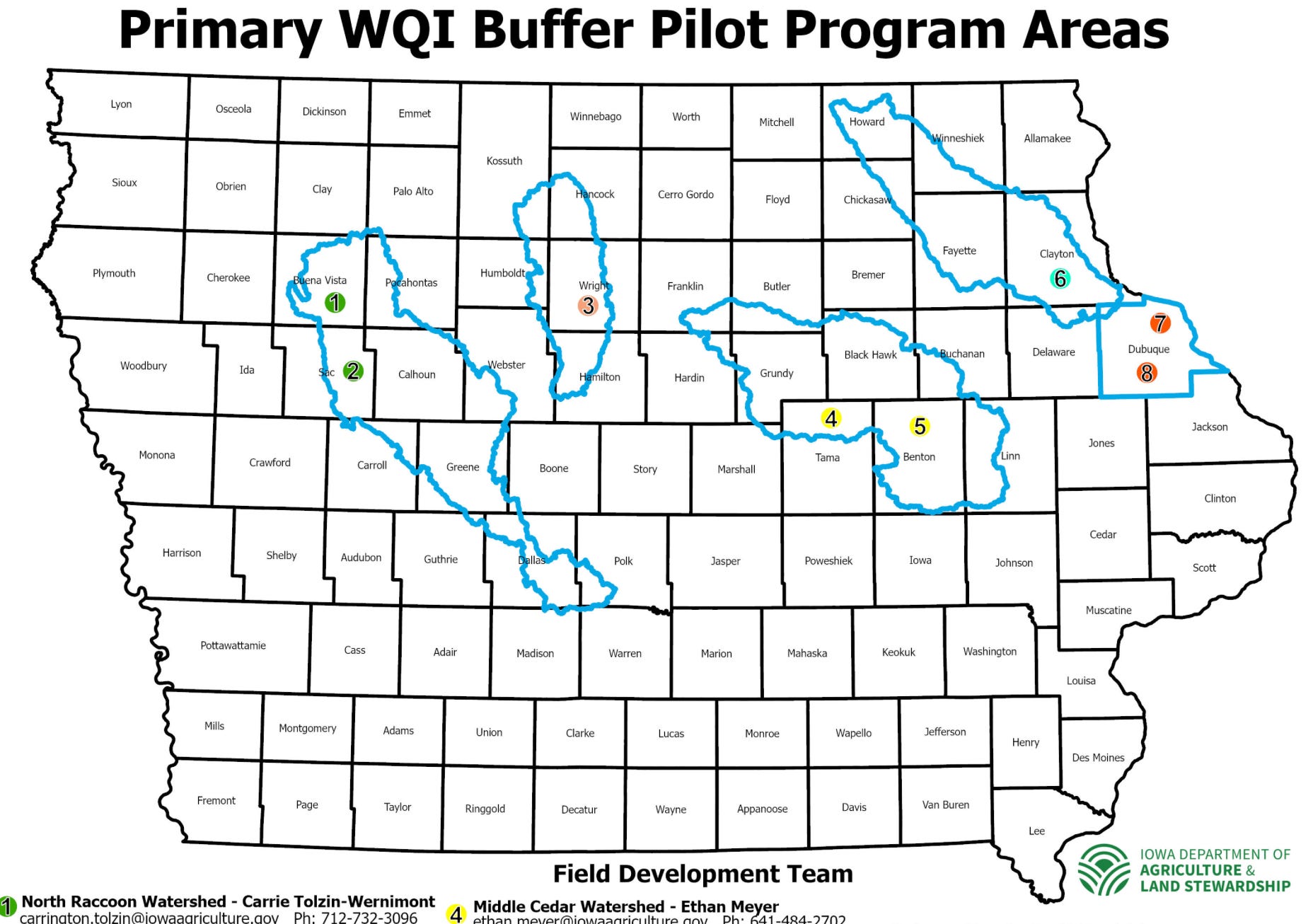
News on August 25 reported Sheriff Mike Naig unholstering his squirt gun yet again to apply a gentle mist onto the raging inferno that is Iowa’s water quality and overall environmental condition. This time it was $3 million from the state’s water quality initiative fund for a pilot project that would install buffer strips (i.e. perennial vegetative cover) along Iowa streams in the Raccoon, Boone, Cedar and Turkey River watersheds, and in Dubuque County. This was headlined by Naig and the media as being targeted to the Des Moines and Cedar River watersheds, most likely to get the attention of urban voters Naig will need next year in his re-election bid.
In the stories, Naig was quoted as saying the Iowa Department of Agriculture and Land Stewardship (IDALS), which he heads, has invested more than $65.8 million in the Cedar Rapids and Des Moines watersheds since 2003. If you’ve followed the water quality news this summer, you’re well aware that Naig might as well have lined every cat litter box and bird cage in the state with that money, for all the good it has done in improving water quality.
It must also be said that $65.8 million in those two watersheds in 23 years is not a lot of money. In total there are about 9 million acres upstream of the cities of Des Moines and Cedar Rapids, so that pencils out to $0.32 per acre per year. The City of Iowa City charges me and every other property owner in town $375 per acre per year to mitigate stormwater pollution from a city lot. You’re likely getting charged similarly if you live in a city with a population greater than 10,000.
And so $3 million for stream buffers in these huge watersheds mentioned above is a fart in a hurricane, at best. But—and this must be said—the environmental effect they could produce is non-zero. I have harped (and continue to do so) forever about unbuffered streams being one of the most disgraceful things about Iowa farming, and so I criticize this program at some risk. But I believe the facts speak for themselves.
Farmers participating in the IDALS buffer program will receive a one-time payment of $250 per acre for establishment costs and $1,500 per acre for foregone income (total $1,750 per acre). A harvested buffer means the plant material can be mowed and baled for hay. It has been reported that if every participant chose the first option, then a total of 850 acres could be enrolled. Farmers with unharvested (i.e. unmowed) buffers will receive doubled payments. IDALS states this land should remain in the buffer for 10 years.
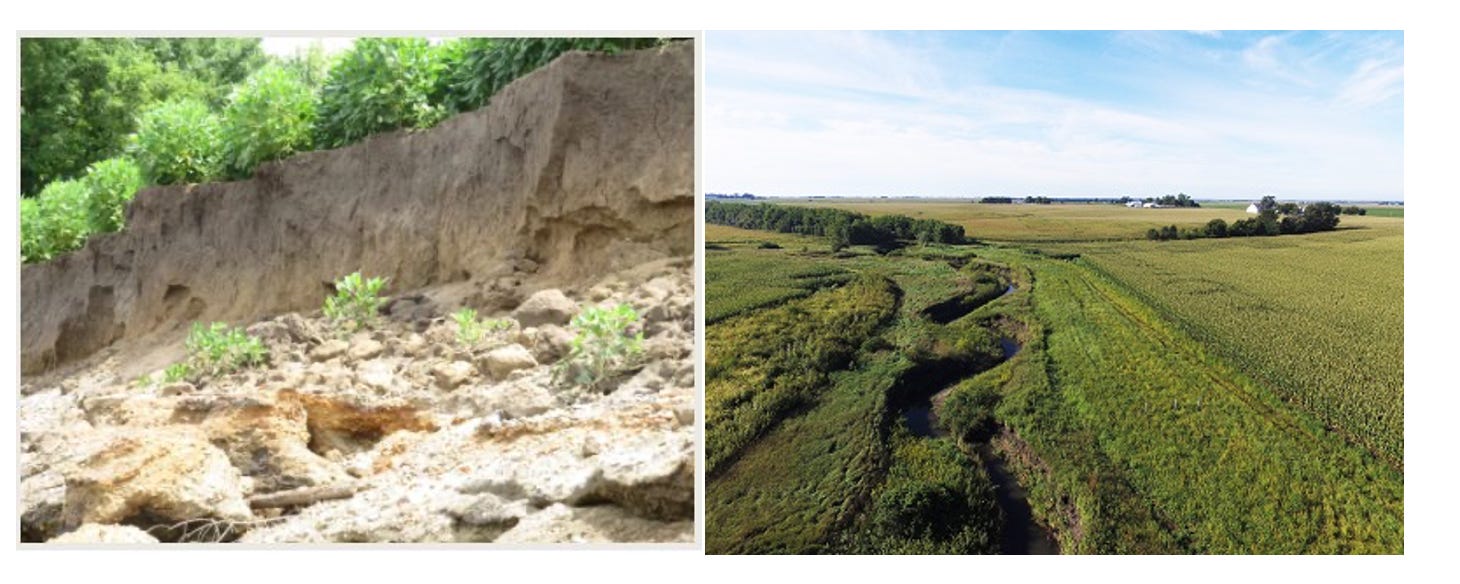
It’s worth noting that the federal Conservation Reserve Program (CRP) offers annual payments of $662.22/acre annually, for 10 years, for riparian buffers in Iowa. So the total payment is $6622.20. The IDALS money is much less (either $1750 or $3500) but all front loaded to day 1. So if you need a new pickup now, you might find the IDALS program more to your liking. One has to wonder what leverage IDALS will have if corn prices shoot up and inspire a participating farmer to plow up his buffer before the 10 years has elapsed. After all, he/she will have all the money.
The news stories have said that cattle will be barred from grazing the IDALS buffers, but two different sources have told me that fencing to restrict cattle access will not be required. So we basically have an unenforceable rule on grazing. Many, many farmers tenaciously insist that cattle must have access to streams, even though public money is available for alternative watering systems. This might be a bigger factor than potential grazing.
The four watersheds eligible for the program (Raccoon, Boone, Middle Cedar and Turkey) along with Dubuque County total about 5.8 million acres in area, or about 16% of Iowa. An educated guess is there are 11,000 miles of streams in that area, 22,000 miles if we count two sides for every stream. At the minimum buffer width of 30’, that would mean the project can buffer 234 miles, 1% of the stream length in the project area. To buffer all the streams in that area would cost $300 million, and all of Iowa, $1.9 billion.
In June of 2015, Minnesota governor Mark Dayton signed into law Riparian Protection legislation that required an average 50’ buffer and minimum 30’ on all public waterways and ditches in that state. This didn’t come completely free to Minnesota taxpayers, as soil and water conservation districts were required to assist landowners with implementation of the water resource riparian protection requirements established in the law. This assistance included planning, technical assistance, implementation of approved alternative practices, and tracking progress toward compliance with the requirements. But suffice it to say Minnesotans did not have to pay farmers billions of dollars to buffer streams. Farmers can be fined for non-compliance.
Here in Iowa we vote for five Soil and Water Commissioners at the county level (Pottawattamie County has 10). Let me say that these people tend not to be flaming environmental radicals; I’d venture a guess that more than half are farmers. Conservation Districts of Iowa (CDI) is the statewide association of the 500 commissioners.
Each year, CDI meets to discuss issues important to soil and water improvement. They propose and vote on resolutions that are then forwarded to the state soil committee at IDALS. If the state soil committee is in agreement with a resolution, a process begins whereby the resolution may become state policy or law if the legislature and governor agree.
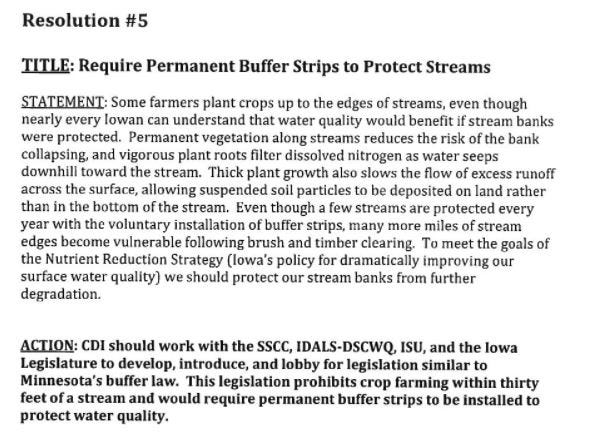
In 2019, CDI passed a resolution (see below) with a super majority to require 30’ buffer strips on either side of Iowa streams, similar to the law passed in Minnesota requiring 50’ average width buffers.
Mike Naig said this in IDALS’ official response: “…incentive-based approaches to delivering conservation practices that are tailored to the landscape - instead of mandatory regulations - are the best way to achieve our state's water quality goals."
The public is being played for fools on this, that Naig’s and Big Ag’s taxpayer funded voluntary approach will more effectively clean up our water than transformative public policy that compels farmers to do what is right.
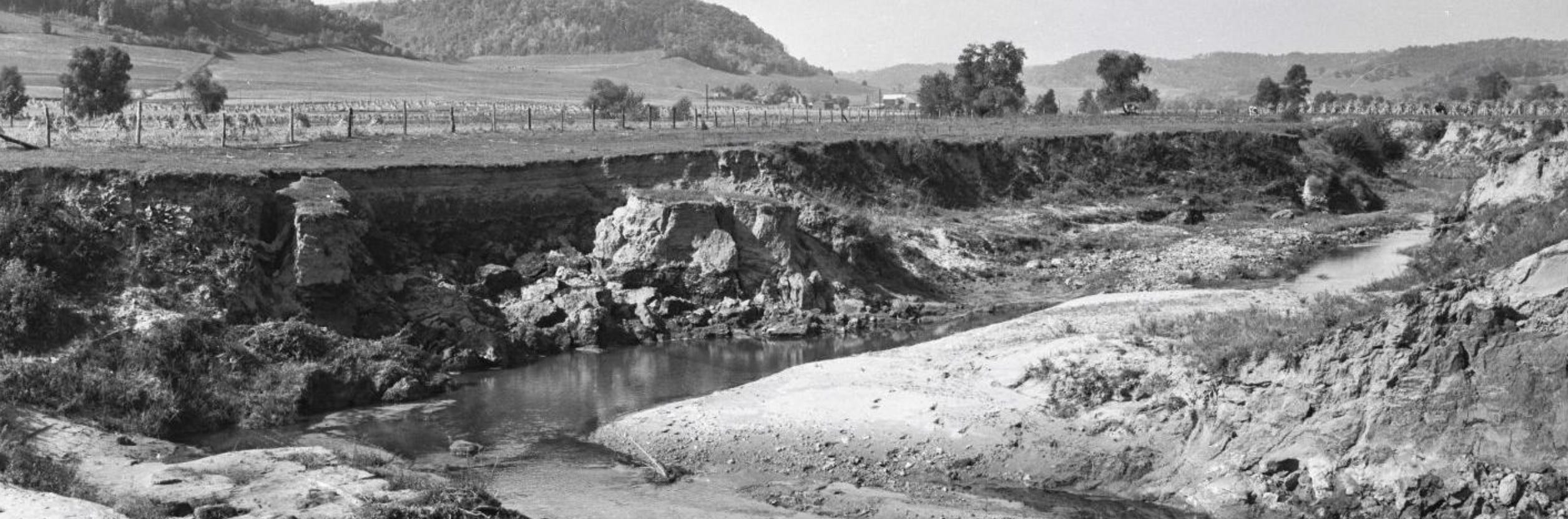
Stream buffers are conservation 101. They are baseline conservation. BASELINE. Aldo Leopold was one of the first to promote stream buffers in 1934 with a Civilian Conservation Corps project in the Coon Creek valley of southwest Wisconsin. Only 91 years have passed and we’re still forced to bribe Iowa farmers with your money to get them to adopt the barest minimum of conservation.
The Cedar Rapids Gazette ran an article on August 30 that had a few folks that work in the Big Pollution Complex commending the new buffer project. I have to tell you, about nothing has made me want to say screw it and give up more than reading that piece. Trump gets less slobbering from his sycophants than Naig gets from the City of Cedar Rapids. My former University of Iowa colleague Elliot Anderson, who has little to gain by sucking up to Naig, offered the most sobering comments about the article by stating “this project is unlikely to improve water quality along the main stems of the Des Moines and Cedar Rivers in a meaningful way.” Elliot is a Cubs fan so he knows a thing or two about ‘sobering’. Stay salty, Elliot.
The argument here isn’t whether or not buffered streams are a good thing. That science was settled decades ago—they are. This discussion SHOULD center around how best to get them. Celebrating this program as directionally correct (a phrase I learned during my four years working on the ag side) or a step in the right direction, nearly a century after Aldo Leopold sold the idea, should be seen as complicit with the foot dragging that characterizes Iowa Ag and water.
We have a system where the careers, reputations, and stature of both individuals and institutions are dependent upon maintenance of the problem in such a way that water quality stays at a level just good enough to prevent public outrage, and the shreds of good news can be spun into bullshit propaganda. Create a scenario where status quo water quality and entrenchment of the current production system is good for the professionals working on the problem and—guess what—improvements in water quality are tiny, backsliding is common, and accountability is measured by dollars spent and not by laboratory tests of the water. You know how many people in Iowa have been bestowed awards for contributions to better water and conservation? Answer: A LOT. Your water still sucks.
I’ve created some bitter enemies and won no friends by pointing this out. Yet there are some in the conservation world that have acknowledged to me privately that they know the score—just get the money spent, they’re told. What I know that many don’t is this: the Big Ag decision makers know the score only too well and exploit this situation to their gain. Oh boy, do they ever. They are oh-so-very-happy to find willing and unwitting partners to help them sprinkle C-notes around the countryside that they can then spin into a whirlwind of good news to a public with a short attention span. Eventually some transition from unwitting to witting. This is a pernicious sort of evil that helps keep your water polluted.
Remember when conservatives in this country used to criticize liberals for mindlessly throwing money at social problems to no effect? I sure do. Here in Iowa, conservatives (Naig, Kim Reynolds) throw good money after bad at Ag pollution while liberals, if it can be said that we have any, stand flat-footed and tongue-tied.
Is a buffer better than no buffer? Yes it absolutely is. But here’s the rub: the water here in Iowa has been shamelessly and shamefully polluted for the entirety of my life, and I’m of the belief that I and every other Iowan deserve far better than baby steps in the right in the direction. We deserve the transformation of the existing agricultural system into one that is good for all Iowans, and not just the ones in farming and agribusiness.
Finally, I’ve been telling this story in my programs and I want to tell it here. President Eisenhower’s Secretary of Defense was a guy named Charles Wilson, who came to the federal government from General Motors. At his confirmation hearing, Wilson famously said that what was good for GM was good for America. That, I think, has been our state’s relationship with agriculture, i.e., what’s good for Iowa Agriculture has been good for Iowa. While that may have been true at one time, it’s my opinion that it is very, very questionable in the present day, as we’re awash in pollution and rural decay is a heartbreaking problem. So very often we can say that what’s good for Big Ag is bad for the rest of us that live here.
Iowans deserve so much better from the industry and their enablers. We won’t get it until we demand it.
There was Charles Wilson in this episode, but there was also a Charlie Wilson who was a Democrat from the state of Texas. He became known in Charlie Wilson’s War. It resulted in successful funding and support of the Afghan mujahideen during the Soviet Afghan war leading to the withdrawal of the Soviet union from Afghanistan. We now have Chris Jones‘s war. Chris Jones is doing everything within his word power to reset the Iowa water landscape. I believe his work will ultimately contribute to the quality water which was meant to be here.
My one quibble: I believe you have won > zero friends by pointing this out. Thanks for the insightful analysis!