

Amid its worst water crisis since the 1993 flood, last week Des Moines water authorities dropped their gloves in true Roberto Duran fashion and cried ‘no mas’, with Central Iowa Water Works Director Tami Madsen announcing the future construction of two new treatment plants to cope with the region’s nitrate problem. One can imagine the bad guys in agriculture crying “Victory is Ours!”, probably from some watering hole in the capital of the Swine Republic (Ames) where their enablers at ISU could join in the revelry if they wanted. Between pitchers of Busch Light (made with real Iowa corn), the ag titans might have handed out those cherished Lifetime Problem Maintainer awards, surely with those little gold seals in the lower right-hand corner, to those faculty and administrators most dedicated to sacrificing the health and well being of 3 million Iowans for those few bushels that keep us one kernel ahead of Illinois for bragging rights to the title of Most Amaizing State in the U.S.

Nobody should consider construction of two new treatment plants as a permanent solution, however, as Des Moines also added treatment plants in 2000 and 2012 to help cope with the nitrate problem. It’s hard to say how much the ‘00 and ‘12 plants cost because capital improvements have been made since they were built, but the two new proposed treatment plants are estimated to cost $344 million. Des Moines Water Works has also considered expanding its Fleur Drive nitrate removal facility ($15 million) and drilling hopefully lower nitrate wells on the north side of the city ($50 million).
It's time we call that $344 million what it really is: one more government subsidy for Iowa Agriculture. The ag titans have steadfastly refused to deal with the pollution they generate, and farmers have mostly followed their lead. So the taxpayers are forced to step in and wipe their smelly ass. If you’re a downstream user of the water resource and want to die of old age and not some ag-caused disease, well, they’ve all but told you to figure that out for yourself. Big Ag now owns Des Moines and is in control of how the metropolitan area will cope with their water pollution. There’s just no doubt anymore.
And if you think this is just a Des Moines area problem, well, I’ve got news for you. Tap water in Cedar Rapids and Iowa City has been running 8-9 mg/L over the last week, just below the Safe Drinking Water Act maximum, but well above the level (3 mg/L) associated with a whole suite of cancers, birth defects, and other maladies. Residents of those cities (I am one): have you heard anything about this from your local city authorities or the elected people in Johnson and Linn Counties? I haven’t. I’m sure they are MORE THAN HAPPY to let Des Moines be a lightning rod on this. Meanwhile, three towns in northwest Iowa can’t drink their water because of high nitrate—Danbury, Early, and Rock Valley—and this has been ongoing since January for Danbury. Water utilities in Manchester and Cedar Falls also have generously fertilized their customers this month, as their treated water has tested above 10 mg/L (Manchester) and 9 mg/L (Cedar Falls).
There are three other angles to this story that are not getting covered right now by the media. Unless I’m the media. I mean, who even knows these days.
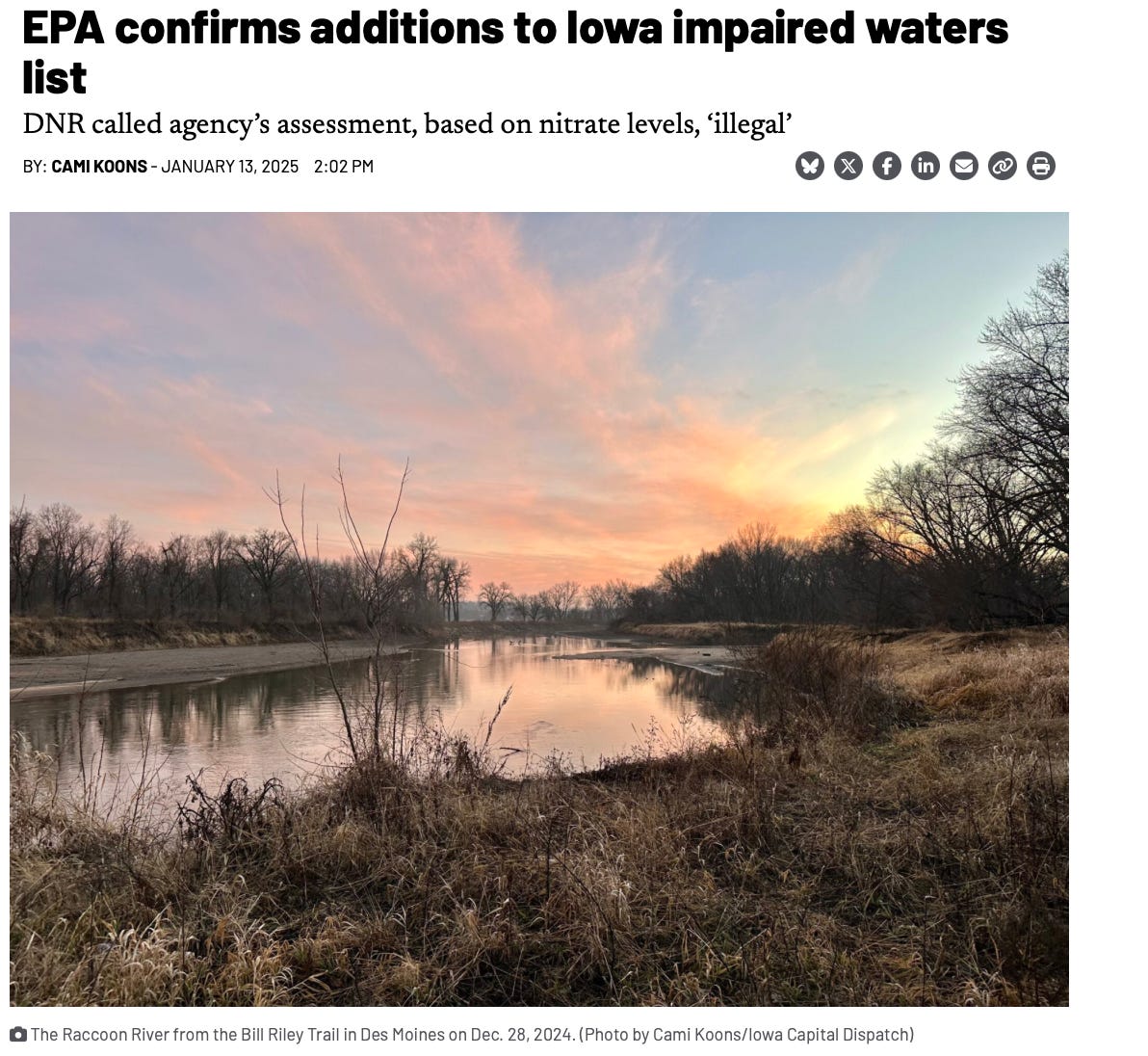
The first angle is something I wrote about almost three years ago when I was still employed at the University of Iowa. I posted about it again here this past January. That ‘angle’ is DNR Director Kayla Lyon’s effort to ‘delist’ the Raccoon, Des Moines, Cedar, Iowa and Skunk Rivers as impaired for nitrate. Impaired, in the context of the Clean Water Act, means because of degradation the water body is not meeting all its designated uses, which in the case of these five rivers means use as a source of municipal supply because of excessive nitrate.
When Lyon first acted on this in 2022, data clearly showed the Cedar especially as continuing to have high nitrate, with 14 mg/L (allowed drinking water maximum is 10) measured by the U.S. Geological Survey only a few months prior. This past November (2024), EPA overruled Lyon and returned the rivers to the impaired list. Lyon formally objected in January, declaring the move ‘illegal’ and contested the decision. “It is safe,” Lyon said in a communication to EPA. All this happened before Trump was inaugurated, so I suppose EPA could change its mind. But one might hope after the past month with Des Moines, Cedar Rapids and Iowa City all walking the Drinking Water Violation Tightrope, sanity will carry the day at EPA.
Permit me to emphasize the perversity of this. In Iowa, DNR (i.e. Kayla Lyon) has regulatory authority over municipal drinking water. Here we have 600,000 people in central Iowa and 300,000 in eastern Iowa exposed to nitrate concentrations well above what a human being should consume in drinking water, and the person in charge of regulating that activity (municipal water supply) is trying to remove the bare minimum of protections for them. In my view this is an egregious derelict of duty and in a sane world would be a career ender in public service for Lyon. But in the country we live in now, my guess is she probably got one of those certificates with the gold sticker in the corner from the Big Ag assholes.
The second angle relates to the first one and that’s the TMDL required for impaired water bodies. TMDL stands for Total Maximum Daily Load. In January I wrote this: “Crazy Theory: When a water body doesn’t meet its designated uses (in this case, municipal water supply), then the required TMDL potentially limits new and expanded discharges into the impaired water. That means point (end of pipe) sources, since agricultural runoff (non-point source) is exempted by the Clean Water Act. I can only think that there are new point source discharges, such as meat packing plants, that will need Clean Water Act discharge (NPDES) permits and that will want to locate in these watersheds. The five river basins of concern (Des Moines, Raccoon, Cedar, Iowa and Skunk) must comprise nearly half of Iowa’s area and population. If you want to open a new discharging entity in one of those river basins, you may need Iowa DNR to ‘make room’ for another discharge if your effluent is going to contain a lot of nitrogen, as most packing plant discharges do.
Case in point, about a month ago (May 23) I was reminded that Daisy Dairy planned to open a processing plant in Boone, Iowa, which is in the Des Moines River watershed. Recall that the Des Moines River is impaired for nitrate, despite Kayla Lyon’s best efforts to demonstrate otherwise. The Daisy facility plans to receive milk from 43,000 cows.

Guess what happens when you process milk into sour cream and cottage cheese? You need to discharge nitrogen (i.e. nitrate) somewhere. By my calculations based on milk from 43,000 dairy cows, about 640,000 pounds of N per year (bear in mind this has nothing to do with the nitrogen content in the cattle manure) will be in the Daisy waste stream. This is enough nitrogen to contaminate 29 billion gallons of river water to a level exceeding the drinking water maximum (10 mg/L). I’m told by DNR that the Boone wastewater treatment plant will figure out a way to reduce the nitrogen sent to it from the Daisy plant. If the Des Moines River was not impaired for nitrate due to its use for municipal supply in Des Moines, as Kayla Lyon wanted, no additional nitrate removal treatment of the Daisy discharge would be necessary, and Des Moines Water Works would have some more nitrate to cope with.
I know, right?
This brings up my third angle and it’s another stop in the same journey. Iowa’s flagship (or sinking ship, as the case may be) water quality policy is the Nutrient Reduction Strategy. Now 13 years old, boy, has it ever worked. If by ‘worked’ you mean it has blown copious amounts of smoke up the public’s collective backside. The nutrient strategy as policy (it’s in Iowa Code) leaves nutrient pollution from agriculture unregulated but regulates nitrogen and phosphorus from municipal wastewater treatment plants.
It's becoming increasingly clear that nitrogen pollution from crop and livestock production is going to be an obstacle to economic development in watersheds that are impaired for nitrate. Any type of operation that generates a nitrogen-containing waste stream needing to be discharged to a river already impaired for nitrate is going to be a problem. Meat packing is one of the biggest point source dischargers of nutrients, but there are many others, as the Daisy Dairy example illustrates. Industry (meat packing and others) needs more tax-payer funded wastewater treatment capacity across the state because there’s no ‘room’, under existing Clean Water Act rules, for more or expanded point source discharges because crop and livestock production have everything so goddamn polluted.
With the water works in the news so much lately, this seems like a good time to congratulate my old boss, Ted Corrigan, on his impending retirement (7/18) as General Manager and CEO of Des Moines Water Works. Ted was the consummate engineer, an engineer’s engineer, and for that, I forgive him. But if you paid attention to the media stories about the Des Moines drinking water situation the past few weeks, the only person in Polk County that had the courage to talk truthfully about the source of the problem was Ted F. Corrigan. (Not sure what his middle initial is, but I’m thinking F works in this situation).
Here’s an old story about Ted. When I was at the water works, of a morning I would commonly go from the lab to the pumping station, this at the Fleur Drive treatment plant. Ted’s office was there at the time. On the other side of the ring levee protecting the pumping station flows the Raccoon River. If the Raccoon was brown and foamy and disgusting and full of nitrate, which it usually was, Ted would declare “where’s the outrage!?” And as I remember it, which may or may not be correct, I would say, “yeah, where’s the f-ing outrage.” I still ask myself that today and almost every day. Where’s the outrage, after all these years.
Des Moines was lucky to have a native south sider (Ted) running things, and if you live in Polk County, just remember that it’s guys like him that protect you from Iowa agriculture.
Has this post been submitted to the DM Register (maybe in an edited less-snarky form)? Keep stirring the outrage! The people of Iowa should stop subsidizing these unrepentant polluters and their elected guardians!
I mean it's clear that enough people in our state simply do not care about our children, we do not care about our people.