
How much corn is enough
Less, actually

Democrats and Republicans alike have been preaching from lecterns in Washington DC about a new biofuels report, Fueling agriculture: biofuels as the catalyst. The report was prepared by the Energy group of the publicly-traded corporation S & P Global, whose services include ‘market intelligence’, independent credit ratings and financial benchmarks using AI and other tools. As my main financial benchmark these days is a monthly deposit into my bank account from the Social Security Administration, you can imagine that most of their described services are beyond the capacity of my cerebrum. My brain cells do tell me, however, S & P executives likely wear $5000 suits, sport $500 haircuts and manicured fingernails, and vacation in the Cayman Islands.
The company was previously known as McGraw-Hill which included the book publishing company. In 2024 they had revenues of $14.2 billion and net income of $3.85 billion.
The report was prepared for U.S. Farmers and Ranchers In Action, a non profit [501C(3)] advocacy group with 700,000 members. Their stated mission is to “demonstrate how U.S. agriculture is helping to solve some of the world’s most pressing challenges, while creating new opportunities for collaboration, information-sharing, and solution development.” Their board includes people from big names in food and agriculture, including Cargill, Nutrien, and many commodity organizations. Poet, the world’s largest producer of fuel ethanol and other biofuels based in Sioux Falls, is also represented on the board.
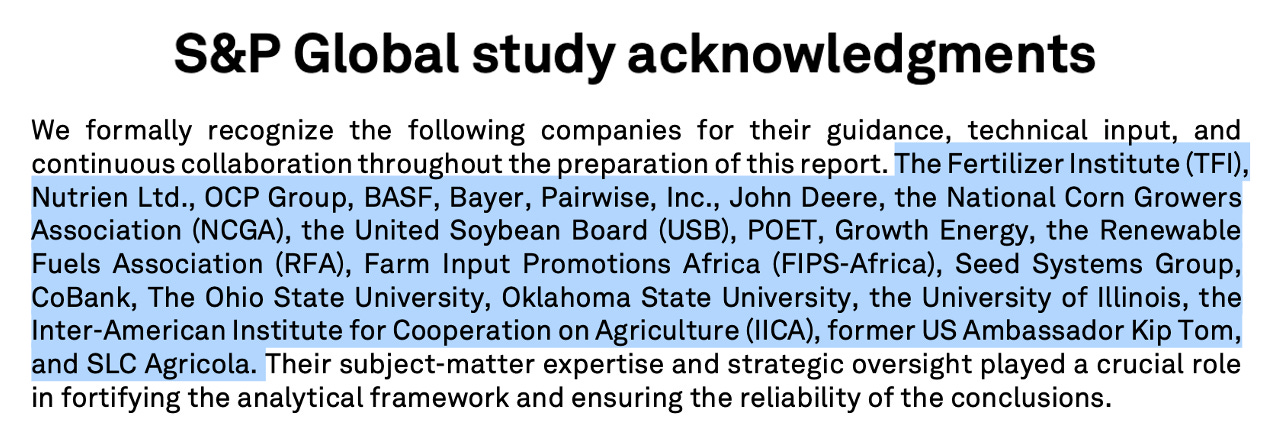
The report is extremely well done and its cost surely must be keeping busy the tailors of $5000 suits at S & P Global’s home base in Manhattan. To summarize its 45 pages in one sentence: Big Ag is soon to be pinched by a stabilizing and then declining world population (after 2050), while per acre crop production continues to increase, and only biofuels can save it. They advocate more corn production to produce more ethanol while ignoring the biophysical reality that more corn means more nitrogen which means more water pollution. The report mentions drinking water nitrate, eutrophication of lakes and rivers, and the Gulf of Mexico Dead Zone not at all.
There are some surprisingly frank admissions in the report:
U.S. Agriculture is already in a market tilted toward supply, rather than demand. World population growth has not kept pace with increasing crop yields, and populations have already stabilized in most industrialized countries. The writing has been on the wall about this for a long time and I can recall suggesting this book to a group of ag retailers when it came out 16 years ago:

Per capita consumption of commodity grains is flat and per capita meat consumption will increase only 0.1% between now and 2050.
Demand for gasoline and other liquid fuels is expected to decline with
vehicle efficiency, shifts in driving patterns, demographics and increases in ownership of electric vehicles. Interestingly, 80% of 18-year-olds had driver’s licenses in 1983; today it’s 60%.
Absent new sources of feed demand, if the U.S. maintains a 10% ethanol blend rate in gasoline, American corn growers would cultivate roughly 34.4 million fewer acres by 2050. Iowa’s corn total corn acreage stands at about 14 million acres now.
Absent new federal mandates to suck up an excess of corn poised to grow faster than actual corn in an Iowa summer, prepare for the apocalypse. S & P Global’s proposed solutions to stopping the apocalypse are limited to this: expand biofuel consumption by reducing ethanol’s carbon intensity index through technology like AI, and then unlock access to fuel markets seeking low-carbon solutions. This will require federal policy like taxpayer-supported carbon tax credits that compel or further incentivize the use of ethanol and other biofuels.

I make no bones about saying that I do not think the future of Iowa agriculture lies with biofuels. According to the Iowa Corn Growers Association, 62% of Iowa corn is being used to produce ethanol. Iowa Farm Bureau Federation data shows that number hitting 70% twice in recent years, the most recent in 2021. In 2021, this would’ve meant corn grown on 9.1 million acres (14,220 square miles) was used for fuel ethanol. That’s 25.5% of the state’s total area and 35% of its cropped area.
It’s safe to say that most farmers are selling corn to ethanol plants. Following enactment of the Energy Policy Act of 2005, which set blending requirements for biofuels (otherwise known as the Renewable Fuel Standard), the ethanol industry has stabilized corn prices by creating a predictable and guaranteed market for the grain, and has provided a security blanket for farmers in the process. It’s also part and parcel of the inflation in Iowa farmland prices since 2005, thereby creating millions of dollars of wealth for the tiny fraction of Iowans and others that own farmland. I often wonder how many pro-ethanol politicians cling to their advocacy because they own farmland and know the value of their investment will surely decline if government required the ethanol industry to stand on its own two feet without the help of policy.
Continuing to double- and triple- and quadruple-down on corn ethanol as one of the fundamental pillars of Iowa agriculture is risky and short-sighted. The industry is and likely always will be COMPLETELY dependent upon government policy for its existence. Are we willing to gamble that D.C. politicians will continue to be supportive of the industry for generations to come, while the demand for liquid fuels seems certain to decline? And we haven’t even mentioned the degradation of our water resources and public health from nitrate and other pollution that results from production of its raw material.
But the political status quoers are going to keep status quoing because campaign donations. And there’s still some residual narrative that won’t die that says corn ethanol is good for the environment. The real tragedy here are the opportunity costs incurred by sticking to the status quo. Instead of investing taxpayer dollars and government policy on new ideas and new technology, we delay further the day when we get a better farming system and better water.
When I talk about ethanol in my programs, it can usually be expected that someone will shout out “what about DDGs?”, always within the context that DDGs help rationalize corn ethanol production. DDGs are Distiller’s Dried Grains, a byproduct of the distillation process whereby corn is made into ethanol. They are used as an alternative to regular corn and soybean feed formulations. Cattle do love DDGs and while there is some evidence of toxic effects, DDGs have been mostly accepted as adequate for cattle nutrition.
When corn is made into ethanol, about 70% of the corn calories end up in the ethanol, while the other 30% lands in DDGs and other byproducts. From this, and assuming 62% of the 13.5 million acres of Iowa corn is supplied to ethanol plants, I can calculate that the calories provided to cattle by DDGs could be met with around 2.5 million acres of corn. Since DDGs are a ‘concentrated’ source of nutrition, for the sake of argument and to be conservative, let’s round up to 3 million acres. Added to the other 38% of corn acres not used for ethanol (5.1 million acres), the total non-ethanol corn area needed in Iowa is about 8 million acres, 5.5 million less than what is actually planted.
Eight million acres is a number that policy makers could try to hang their hat on when thinking about the future of Iowa agriculture where world population growth is zero and corn ethanol isn’t a thing. Admittedly, this ignores the expected continued increase in crop yields with new hybrids and GMO varieties, but other factors such as climate change might start to pinch that. So let’s say eight million acres is what we should plan for. That means we need to develop strategies to transition about 5.5 million acres to something else in the coming years. 2050 is not that far away. Even I might be alive in 2050, awaiting my next social security check.
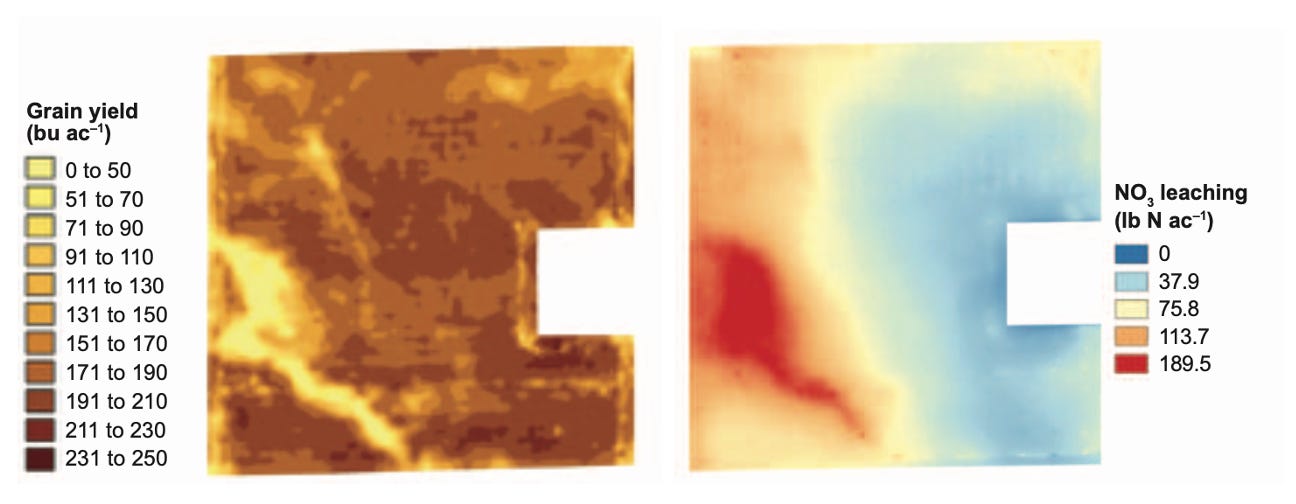
We should first start with the unproductive corn acres. We know around 10% of Iowa corn acres NEVER make back the cost of production and would not be planted to corn, EVER, were it not for tax payer funded programs like subsidized crop insurance (citations 1, 2, 3, 4, 5 below). That number could be as high as 15%. These often, but not always, are not wide swaths of a field but rather ‘spots’ that would be difficult to transition to other working land uses, say oats or pasture, for example. They could provide important wildlife habitat, especially if they are ephemerally or continuously wet. But some could definitely be worked, such as the southwestern corner (lower left) of the field shown below. It loses A LOT of money, along with A LOT of nitrogen to the environment. Almost every farm has areas like this that hemorrhage both money and nitrate and are farmed only because it’s convenient and the taxpayer indemnifies it. Why do policy makers turn a blind eye to this? Because big corporate agribusiness wants to sell seed and other product on those acres—they offer no discounts for ‘bad’ acres. And corporate agribusiness donates generously to our politicians.
What are the something elses that we could. do with ethanol acres?
Oats: Right now the United States imports about 80 million bushels of oats per year from Canada (6). The U.S. also imports oats from as far away as Finland, if you can believe it. As much as 75% of those imported Canadian oats (60 million bushels) come right here to Iowa, to the Quaker plant in Cedar Rapids. Iowa is a good place to grow oats: average oat yield in Iowa last year was 92 bushels per acre. 60 million bushels divided by 92 bushels per acre amounts to 650,000 more oat acres in Iowa. (Yes the whiners and whatabouters harangue me about quality, profitability, test weight and a dozen other reasons why this can’t be done. My answer: talk to an Iowa farmer currently growing oats. It can be done). Oats also provide soil health and pest benefits that make the corn and soybean cycles of an extended crop rotation more profitable.
Pasture: We have a little over 1 million beef cattle ‘on feed’ in Iowa. This means they’re in a confinement of some sort—often feedlots. A cow-calf pair needs about 2.5 acres of pasture in Iowa. So theoretically, we could use 2.5 million acres of corn ground for pasture. Hogs and chickens can also be grazed.
Fruits and vegetables: In the U.S., about 16 acres of fruits and vegetables are needed per 1000 people. In Iowa we have about 2.2 acres per thousand people (7), so we import the vast majority of what we eat from elsewhere. About 50,000 acres of current corn ground converted to such production would provide us with what we could eat and leave some for export. Of course we would still import some fruit and vegetables in the winter.
Perennial crops: This could include grains like kernza and others. Also switchgrass grown for bioenergy/biofuel production (3).
Fiber crops: Hemp is the best example.
Others. Tree nuts, trees grown for lumber, wheat, barley.
I’m already more than halfway to that 5.5 million acre number of acres that are chronically unprofitable and are frequently planted to corn for ethanol. I’ve also reduced the nitrate load in the state’s streams by about 80 million pounds per year. And yet, I still haven’t talked about solar power generation.
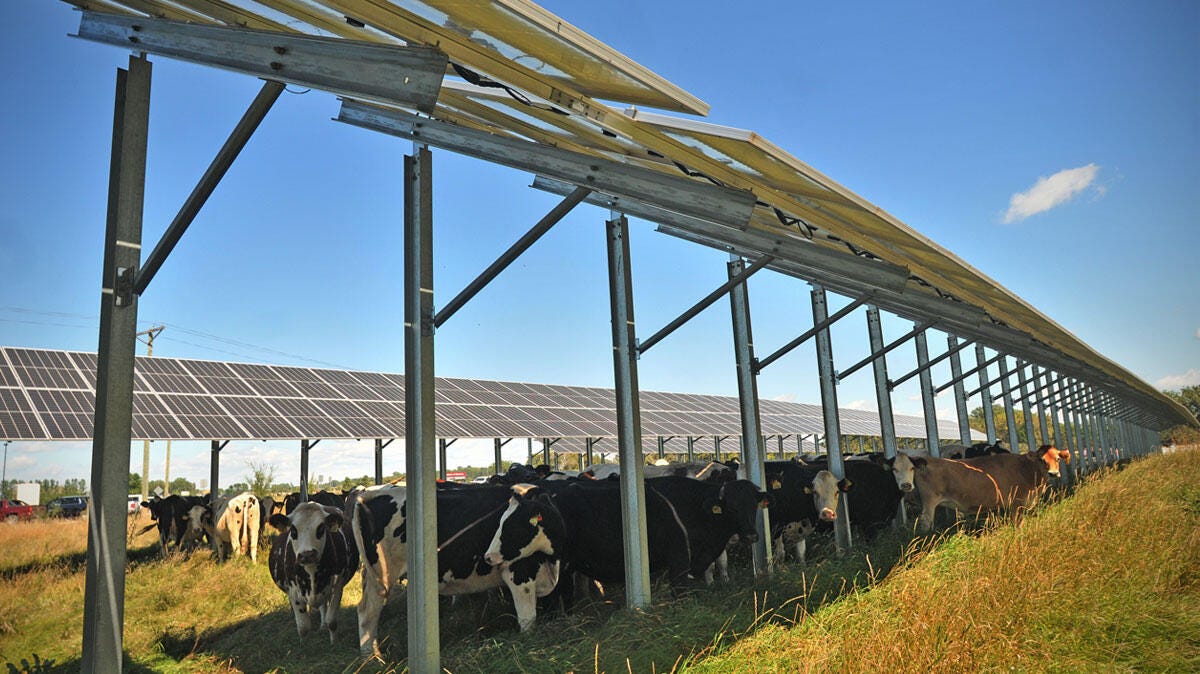
One acre of solar panels produces more energy than 100 acres of corn grown for ethanol. So ALL the energy currently generated by our 8-9 million acres of corn grown for ethanol could be generated by solar on only 85,000 acres. This land DOES NOT have to be removed from agricultural production; cattle and crop production can comingle with solar power generation and examples are abundant.
You may, like me, find the tenacious devotion to petroleum and corn ethanol by some in society bewildering, along with the quite common revulsion to using farmland for solar. This ignores the fact that corn grown for ethanol is solar power generation, albeit a much less efficient and much more polluting method. A good friend explained it to me thus: Solar panels are a passive way to generate energy. It requires little or no work once the panels are in place. Petroleum and corn ethanol, on the other hand, are exhibitions of dominance, a social dominance of nature. And if Iowa agriculture is about anything, it’s dominance.
Citations
Muth, D., 2014. Profitability versus environmental performance: Are they competing?. Journal of Soil and Water Conservation, 69(6), pp.203A-206A.
Brandes, E., McNunn, G.S., Schulte, L.A., Bonner, I.J., Muth, D.J., Babcock, B.A., Sharma, B. and Heaton, E.A., 2016. Subfield profitability analysis reveals an economic case for cropland diversification. Environmental Research Letters, 11(1), p.014009.
Brandes, E., Plastina, A. and Heaton, E.A., 2018. Where can switchgrass production be more profitable than corn and soybean? An integrated subfield assessment in Iowa, USA. GCB Bioenergy, 10(7), pp.473-488.
Basso, B., Shuai, G., Zhang, J. and Robertson, G.P., 2019. Yield stability analysis reveals sources of large-scale nitrogen loss from the US Midwest. Scientific Reports, 9(1), p.5774.
Swinton, S.M., 2022. Precision conservation: Linking set‐aside and working lands policy. Applied Economic Perspectives and Policy, 44(3), pp.1158-1167.
Sosland, J. Opinion: Oats example of misguided US trade approach. World Grain, April 29, 2025.
Swenson, D. Measuring the Economic Impacts of Increased Fresh Fruit and Vegetable Production in Iowa Considering Metropolitan Demand. A Technical Report Submitted to the Leopold Center for Sustainable Agriculture. April 2011.
What I like about this, and your other posts, Chris, is that you do not just broad brush what shoud happen, you actually provide real potential solutions, backed up with evidence. Guess who I'm voting for for Iowa Agricultural Secretary!
Finally real talk about population and resources. They are out of balance as badly as spending and taxes. We're living on borrowed time in more ways than one.