
Nitrini on Ice
....with a garnish of contagious viruses

You may have heard that stream nitrate concentrations around Iowa have been high the past couple of weeks. Des Moines Water Works began removing nitrate in their Fleur Drive treatment facility to keep tap below the EPA maximum of 10 mg/L as N. Water from the Raccoon and Des Moines Rivers, which supplies that plant, has contained nitrate above that level for a while now.
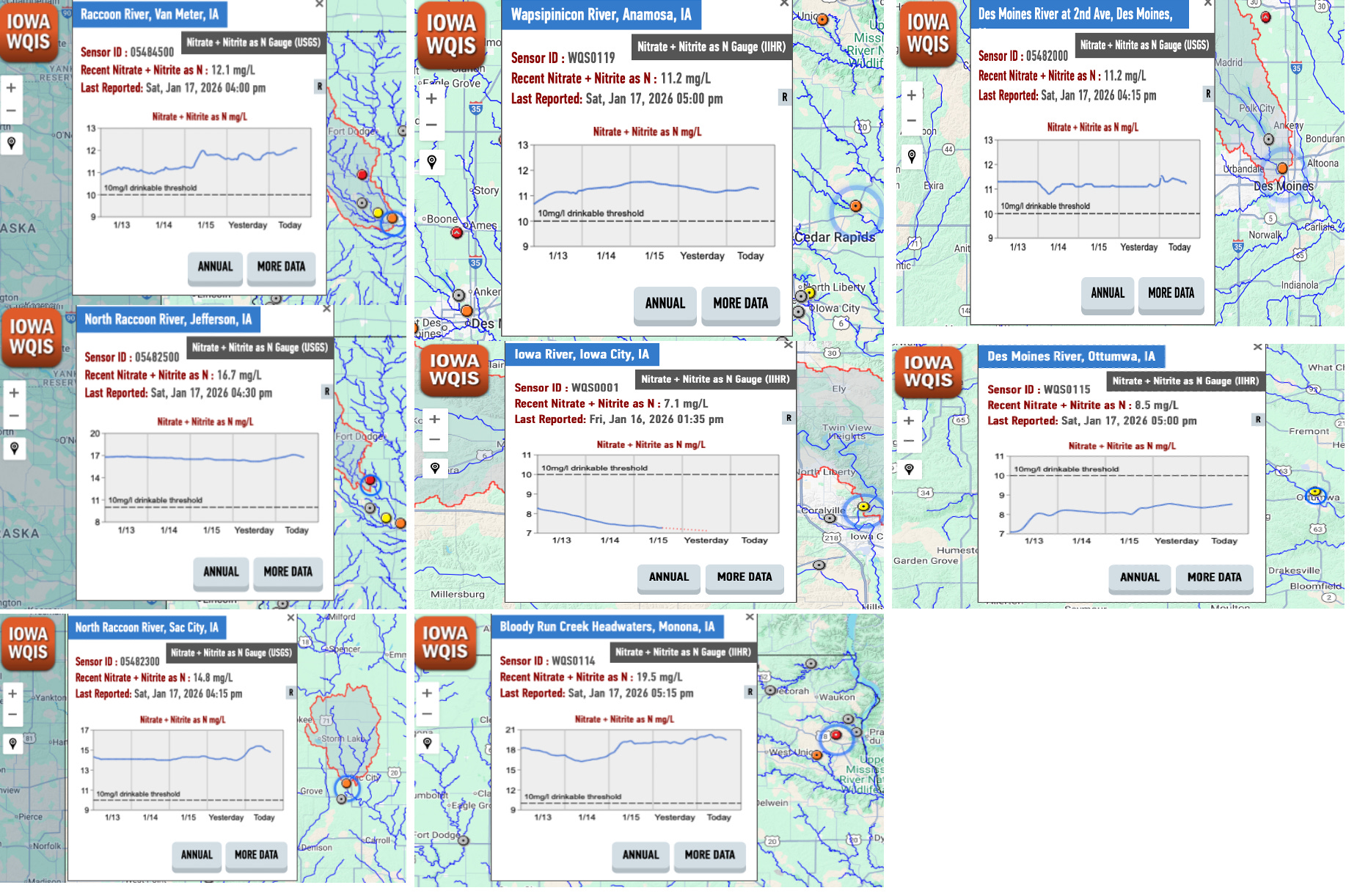
Although high winter nitrate is not unheard of, nitrate removal at Des Moines this time of year is rare. This marks only the fourth winter since construction of the nitrate mitigation plant (1992) that removal has been necessary, and the first since 2015.
Why are nitrate concentrations so high right now? A: It’s the convergence of four factors.
The supply of nitrate-nitrogen on the landscape is high. This is always true to some extent, but likely is higher now because excess nitrogen applied during the dry regime (2023-4) still remains and may take years to bleed off. It’s interesting that Iowa just had record harvests for both corn and soybean. This tells you just how much excess nitrogen we are using. A LOT. Nitrogen is removed as both corn and soybean grain is harvested. Record harvests mean record amounts of N removed; that enough remains to shoot these rivers into sky-high nitrate territory is really saying something.
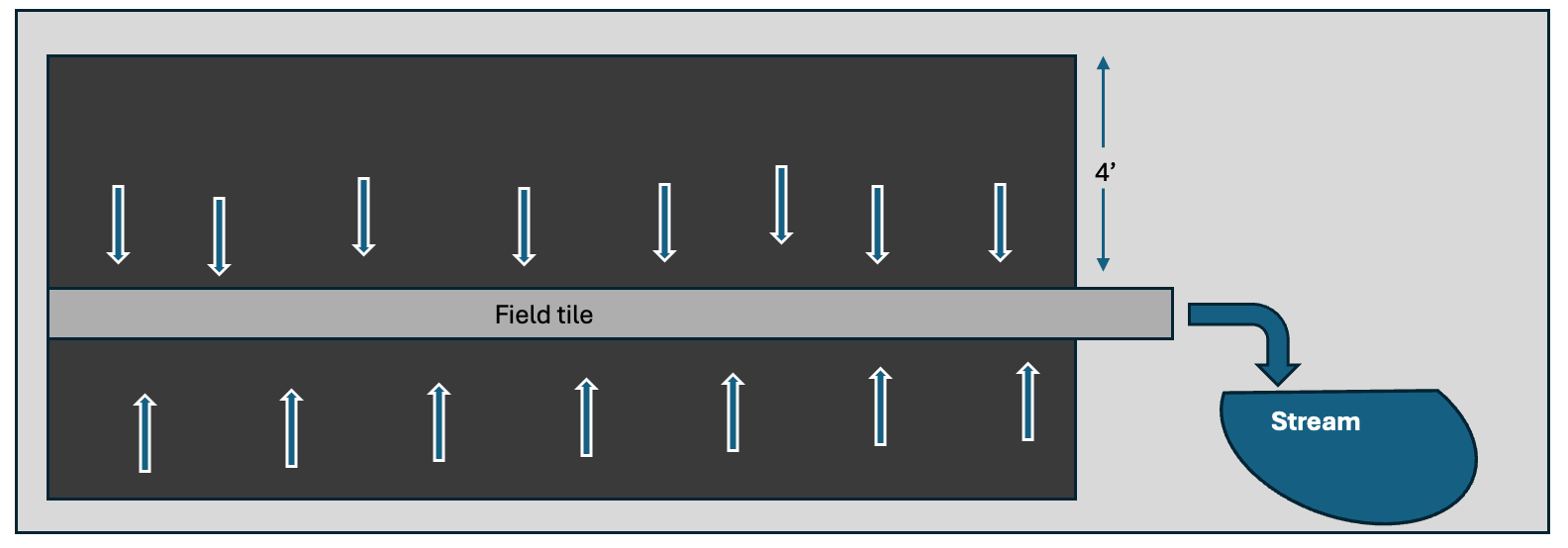
Warm weather has prevented deep frost. A large portion of stream nitrate is sourced back to agricultural field tiles (pipes) which lower the water table in tiled fields. Common practice is to install tiles to a depth of 4’. Frost below that depth freezes up flow of water to the tiles and by extension interrupts that source of nitrate. Deep frost prevents flow of water to the tiles from both above (water table aquifer) and below (deeper groundwater migrating upward).
Shallow groundwater around and near the streams is likely super-charged with nitrate from the large losses from fields this past summer. Flow of groundwater to streams is almost never interrupted, even in the coldest and driest weather conditions.
Nitrate in river water is consumed by algae and other microorganisms, lowering the concentration. This only happens, however, when the water temperature is above 50 degrees F or thereabouts. Water temperatures now are 32-40 F and thus any nitrate in the stream goes unprocessed.
During last summer’s nitrate event, the new regional water utility, Central Iowa Water Works (CIWW) essentially rationed water for several weeks to stay within the capacity limits of DMWW’s Fleur Drive nitrate removal system. There were some remarks in the media that Des Moines and CIWW had inadequately prepared for such an event. Sort of like blaming a battered spouse for not arming themselves. Iowa state senator Mike Bousselot said the utility’s request of customers to reduce water use was a conspiratorial effort to make agriculture look bad.
The spitballs climate change is pitching toward Iowa are wickedly erratic and difficult to predict. The climate here is already extreme by virtue of our mid-continental location. As precipitation becomes ever-more boom-and-bust and the landscape ever-less resilient with bushels-or-bust farming, water utilities increasingly will be forced to over-design systems that they can be sure will endure the worst when it comes to nitrate and other types of pollution.
On the ag side, the approach has been to sprinkle a $10,000 here and $50,000 there and $1,000,000 over yonder on bandaids, tourniquets and plus-sized Depends that are good props for political types and ag comm shops but do little to put a dent in the state’s nitrate load. These edge of field treatments like saturated buffers, wood chip bioreactors, and constructed wetlands, really don’t offer much hope as a landscape-scale solution, don’t work in the winter, and like a shitty diaper may need refreshing from time to time. New drainage tile installation, more commercial fertilizer, and more animal manure dwarf any expected benefit.
In recent Ag news, Iowa Secretary of Agribusiness has prioritized climate. The business climate, that is. He’s sent the so called Iowa Farm Act over to capital hill for Democrats to review and Republicans and ag advocacy organizations to slobber on. New ideas or proposals to clean up our foul water are limited to “requesting a modest 1.6 percent budget increase of $1.335 million to maintain essential operations in animal health, food safety, consumer protection, and water quality initiatives that support Iowa farmers, consumers and rural communities.” Meanwhile the state has spent $5 million only in the last year ($70 million in total) to help bring more E15 and E85 fuel pumps to a gas station near you. Gotta have our priorities straight, dontcha know.
What strikes me about Naig’s ‘Act’, is the focus on contagious disease amongst livestock animals. If there’s anything about Iowa agriculture that should make you lay awake at night, it’s the potential for disease to cross over from Confined Animal Feeding Operations (CAFOs) to the human population. These are what we call zoonotic diseases. Influenza viruses (especially Influenza A) fall into this category, as they can cycle through swine, poultry and human populations. We have 3 million people, 25 million hogs, and 50-70 million egg laying chickens, the last depending on how many are dying in any given month from influenza.
To wit, here’s a sampling from Naig’s press release:
“This package expands economic opportunities, supports the next generation, and strengthens our readiness to respond to animal disease threats.”
“The Iowa Farm Act strengthens Iowa’s ability to respond quickly and effectively to a foreign or major animal disease outbreak by improving coordination, expediting the deployment of equipment, and protecting producer confidentiality,”
“The North Central Poultry Association actively supports the Iowa Farm Act for strengthening safeguards against highly pathogenic avian influenza such as enhancing foreign animal disease preparedness and protecting producer confidentiality.”
“Rapid response and farmer support are critical when a foreign animal disease or other major disease outbreak occurs on an Iowa farm.”
“The Iowa Farm Act is a forward-looking proposal that expands economic opportunities, delivers targeted tax relief, supports beginning farmers, strengthens biosecurity and foreign animal disease response, and improves the efficiency of state government.”
"“The Iowa Farm Act strengthens Iowa’s readiness and protects producers during disease events by:
Safeguarding producer confidentiality during a foreign animal disease or major disease outbreak to encourage early reporting and rapid response without fear of public exposure.
Authorizing the Department to lease space for storing foreign animal disease response equipment, ensuring faster deployment and a more coordinated response.
If we can reduce the likelihood of livestock animal disease and its crossover to humans, we should do that. But Iowa’s approach to this is strikingly similar to our approach to water quality: a band-aid-filled first aid kit strategy that fails to address the underlying risks and causes intrinsic to confining thousands (or in the case of chickens, hundreds of thousands) in a building about the size of the 20-room hotel at rural northwest Iowa crossroads from whence I type this sentence.
My take on the Naig Act is that somebody somewhere is awfully worried about this.
We are so screwed if there's another pandemic. The leadership of this state has rewritten history to conclude that we did too much COVID-19 mitigation. If another deadly virus starts spreading, we won't even take minimal steps to protect vulnerable people.
I'm older than dirt, a southern gal with a love of science and enough smarts to care about addressing problems. Outside of once tending a backyard garden (no longer able) I have a barely rudimentary knowledge of the challenges faced by farmers, but I care. I'm heartened to read your assessment but wish that a wider audience of the people who need to know this were reading this and not me. Still, I want to thank you. I wonder if young people who are savvy about the real dangers know you exist. I'm betting that some bright young people are capable of seeing the harm and need for real change and could learn from you. I wish you the best.