
Stop the Insanity

Iowa politicians of both parties, including Iowa Secretary of Agriculture Mike Naig (Cedar Rapids Gazette, February 12, 2022), are clamoring for federal government approval of year-round E15 blended gasoline. E15 is a blend of straight gasoline (85%) and ethanol derived from corn (15%). Recall that E15 is currently not allowed in the summer months because it increases ground level ozone and smog.
To the glee of Naig, Governor Reynolds and the biofuels industry, Iowa and seven other Midwestern states already were given approval to sell E15 in the summer of 2025. E15 sales in Iowa grew more than six-fold from 2019 to 2024, increasing from 42 to 256 million gallons per year. Here is how the propaganda people push the product at the gas pump:
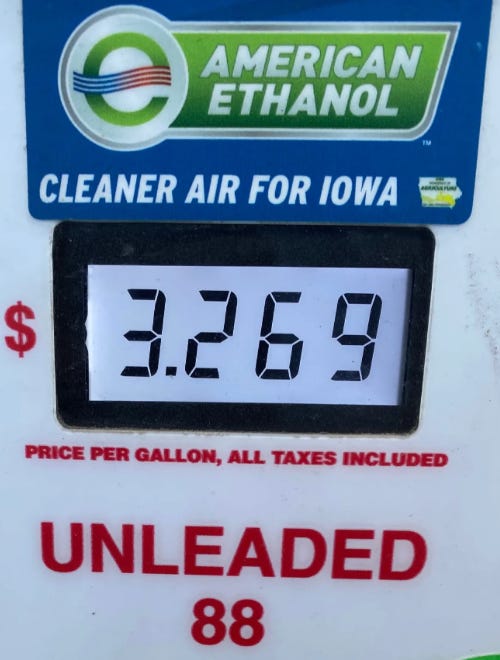
E15 has an octane level of 88. The higher the rating, the greater stability (i.e. less engine knock) the fuel will have in high-compression engines. Octane 87 is better performing in standard engines and older vehicles. Often times you’ll see caricatures of fancy, hip, and young people filling their equally hip vehicle with E15 (octane 88) while projecting an increased environmental awareness. Maybe with a kayak on the roof rack, for example.
Remember that E15 increases ground level ozone and smog. Below is a map showing the changes in ozone levels by state over the past few years, this from the American Lung Association.
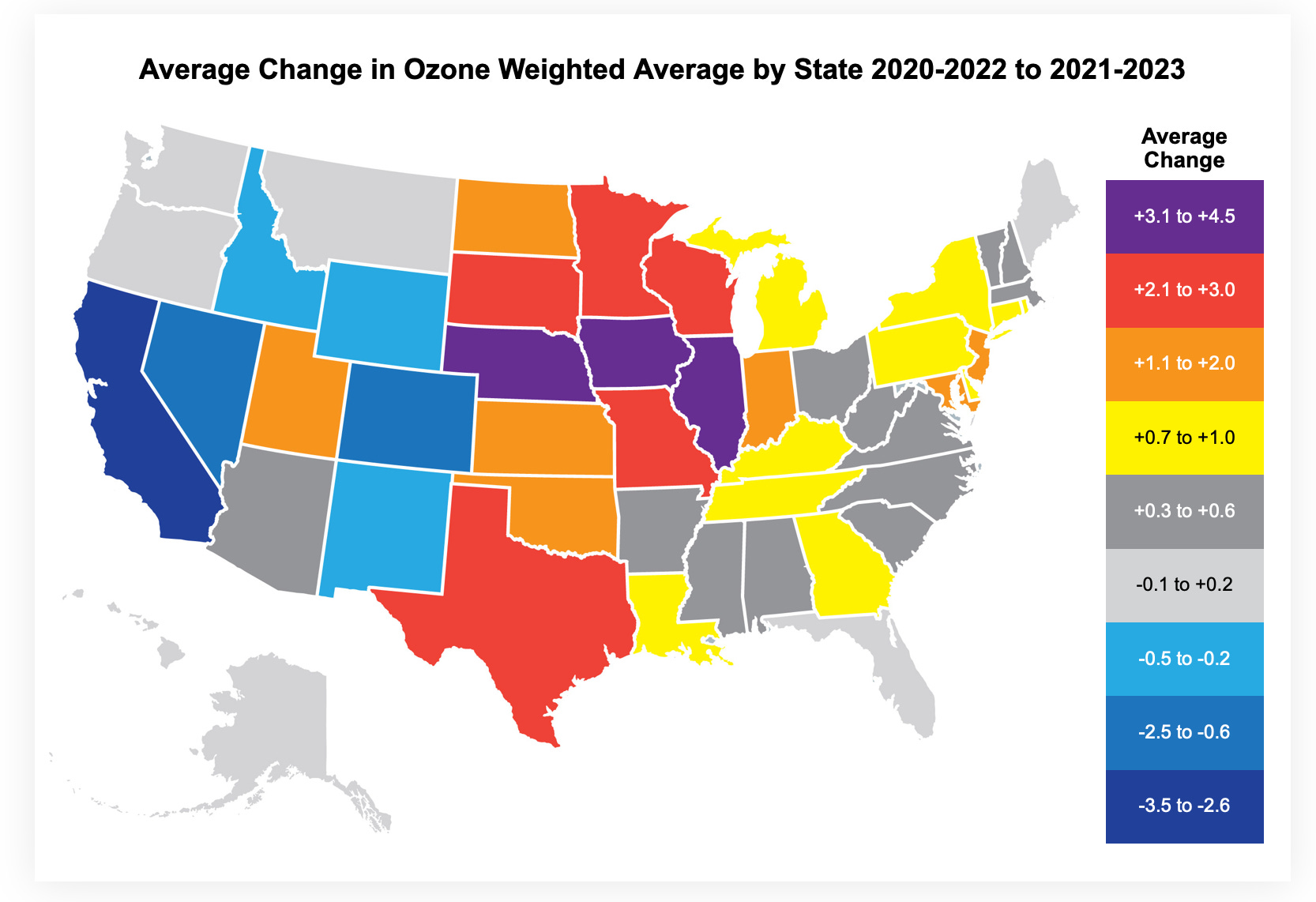
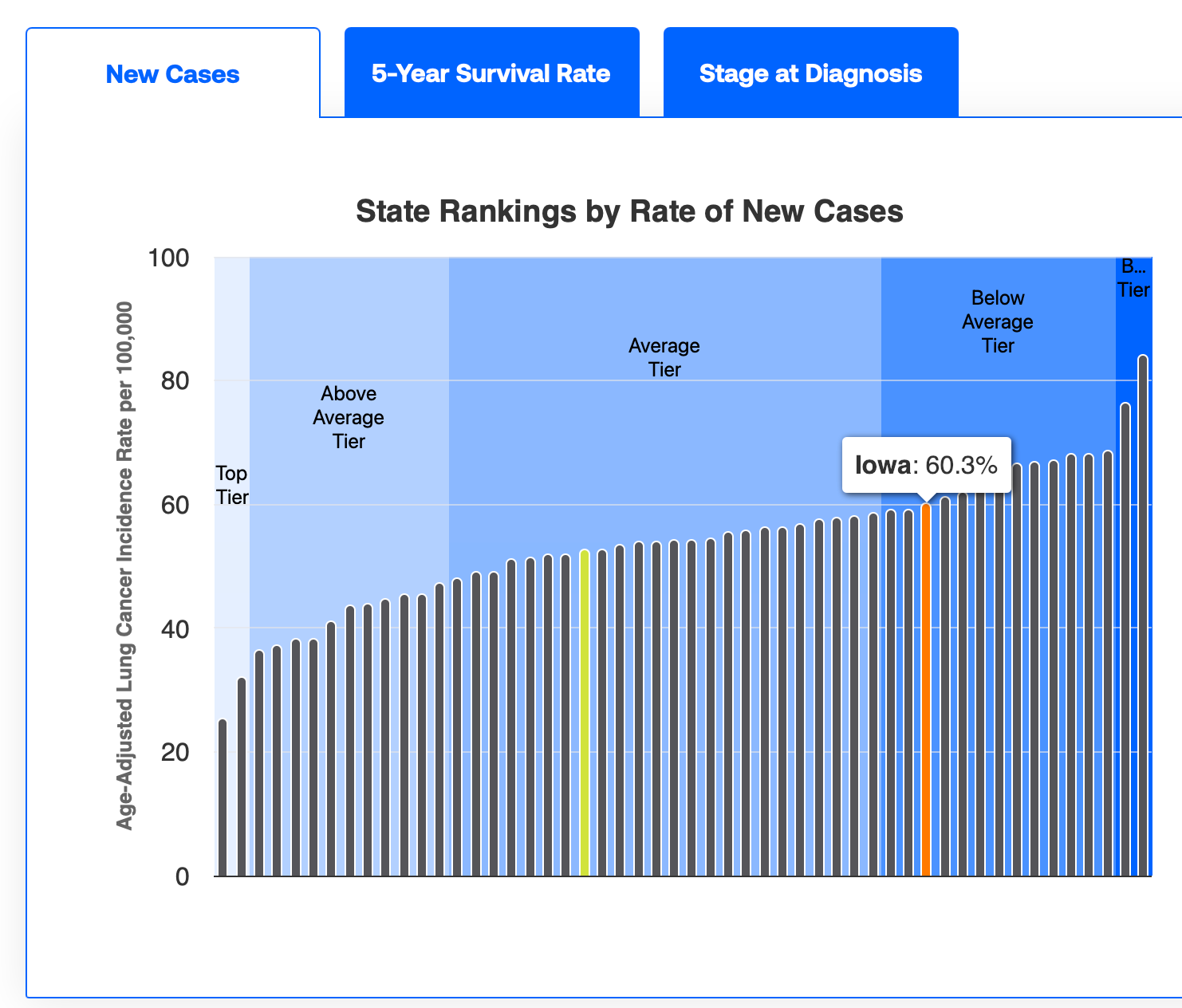
Smog contributes to cardiovascular diseases (stroke, ischemic heart disease), respiratory illnesses (COPD, pneumonia, asthma), lung cancer, and diabetes. Do you find it curious that there is a bipartisan political consensus to promote a smog-enhancing fuel in the state with second-highest overall cancer rate and a lung cancer rate 7.5% higher than the national average? I find it curious.
If you’ve lived in Iowa over the past 30 years, you’ve been forced to swallow an ocean of biofuel bullshit. Most don’t question the accuracy of the propaganda and in fact I can hardly blame people for becoming numb to it. Gas stations, especially the newer, fancier variety, are a veritable Times Square of ethanol advertising. University of Iowa and Iowa State University sports teams, stadiums, stars and coaches promote biofuels like Don Draper pitched Lucky Strikes. Publicly owned vehicles are adorned with all manner of biofuel banners and stickers.
Corn ethanol’s toll on our water quality and environmental condition is abundantly clear to anyone with eyes. Growing corn for ethanol delivers 190 million pounds of nitrate nitrogen to Iowa streams in an average year. That’s enough to pollute 2 trillion gallons of water with nitrate above 10 mg/L, the EPA standard, and more than 6 trillion gallons to 3 mg/L, the level in drinking water associated with several cancers. It also dislodges 92 billion pounds of soil from Iowa farm fields—every year on average. A cynic might say decorating gas stations like Times Square is an effort to distract you away from the environmental damage.
For all this, we’re asked to hang our hats on a couple of things. One is jobs. The advocacy organization for the industry says ethanol “supports” about 52,000 Iowa jobs.
Well, I happen to know a guy. He was an economist at Iowa State until a couple of years ago, when he retired.
He was asked to do an estimate of the number of jobs ethanol created for both Iowa and the U.S. back in 2011 (1). There were 40 ethanol plants in Iowa at the time (now there are 41 or 42 I believe). At that time he determined that Iowa’s ethanol plant workers produced a ‘mulitipler’ effect by creating other jobs, especially truck drivers to haul corn but also high levels of skilled pipe‐fitting, mechanical, and electrical maintenance workers, especially on the front end of plant construction and startup. Ethanol plants also create a labor demand to purchase grain origination services, and for accounting, financial, and legal services. All in all, this multiplier amounted to 3.7. Iowa Workforce Development says there were 1868 workers in ethanol manufacturing in 2024. 3.7 multiplied by 1868 equals 6911 jobs in Iowa created by ethanol. These methods were validated in other scholarly literature (2). Not surprisingly, this report has been hidden better than Poe’s gold bug and I’ve never heard a single politician mention it. Almost all instinctively grab onto the shiny objects tossed about by the biofuels industry.
Let’s consider that jobs number, 6911, for a moment. The Iowa Corn Growers Association says 62% of Iowa corn goes to ethanol. USDA says 13.5 million acres of Iowa land was planted for corn in 2025, so 62% of that is 8.37 million acres, or 13,078 square miles. (I’ve been saying 11,000 in my speaking programs, I guess I needed updating.) 6911 jobs divided by 13,078 square miles amounts to 0.53 jobs per square mile of the best farmland on earth. If that doesn’t sound like much to you, well, it isn’t.
Take Michigan, for example. The state is the #2 apple producer and orchards occupy a mere 38,000 acres of the state’s land. If we only count jobs in Michigan packing plants (about 4000), the industry has created 67 jobs per square mile of land farmed to apples.
Has ethanol been good for the Iowa farmer? It depends on who you ask and what your definition of ‘good’ is. There’s no denying that the guaranteed market for corn created by the Renewable Fuel Standard (RFS) baked in a durable increase in the per bushel corn price. The problem the biofuel industry has (and they are painfully aware of this) is that there is a stagnant demand for petroleum-based liquid fuels and that is not going to change any time soon as renewables expand. They’re responding with stopgap schemes like year-round E15 and the carbon credits that they hope will bear fruit once the CO2 pipelines are built.
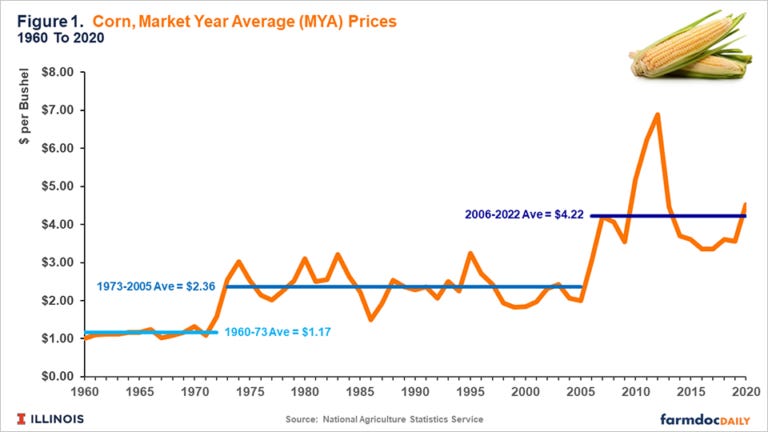
Another problem that perhaps was not anticipated by Iowa’s biofuel industry and other agricultural interests back in 2005 was that by creating a guaranteed market for corn, the U.S. government also inspired a whole lot of farmers around the country to plant the crop where previously it was not grown. In 2005, Iowa claimed 15.7% of all the corn acres in the U.S.; 2025, 13.9%. Since most of our farmable land was already farmed in 2005, and since we really didn’t grow much other than corn and soy even then, there wasn’t much room for growth in corn acreage in Iowa. What room we had was a our marginal and environmentally vulnerable land.
Other states, however, had a greater diversity of crops they could displace with the King. In the 21 years from 2005 to 2025, another Iowa was created within the borders of just 6 states: North Dakota, Kansas, South Dakota, Minnesota, Nebraska and Missouri. Translation: the increase in corn acres in those states alone matched the existing corn acres in Iowa.
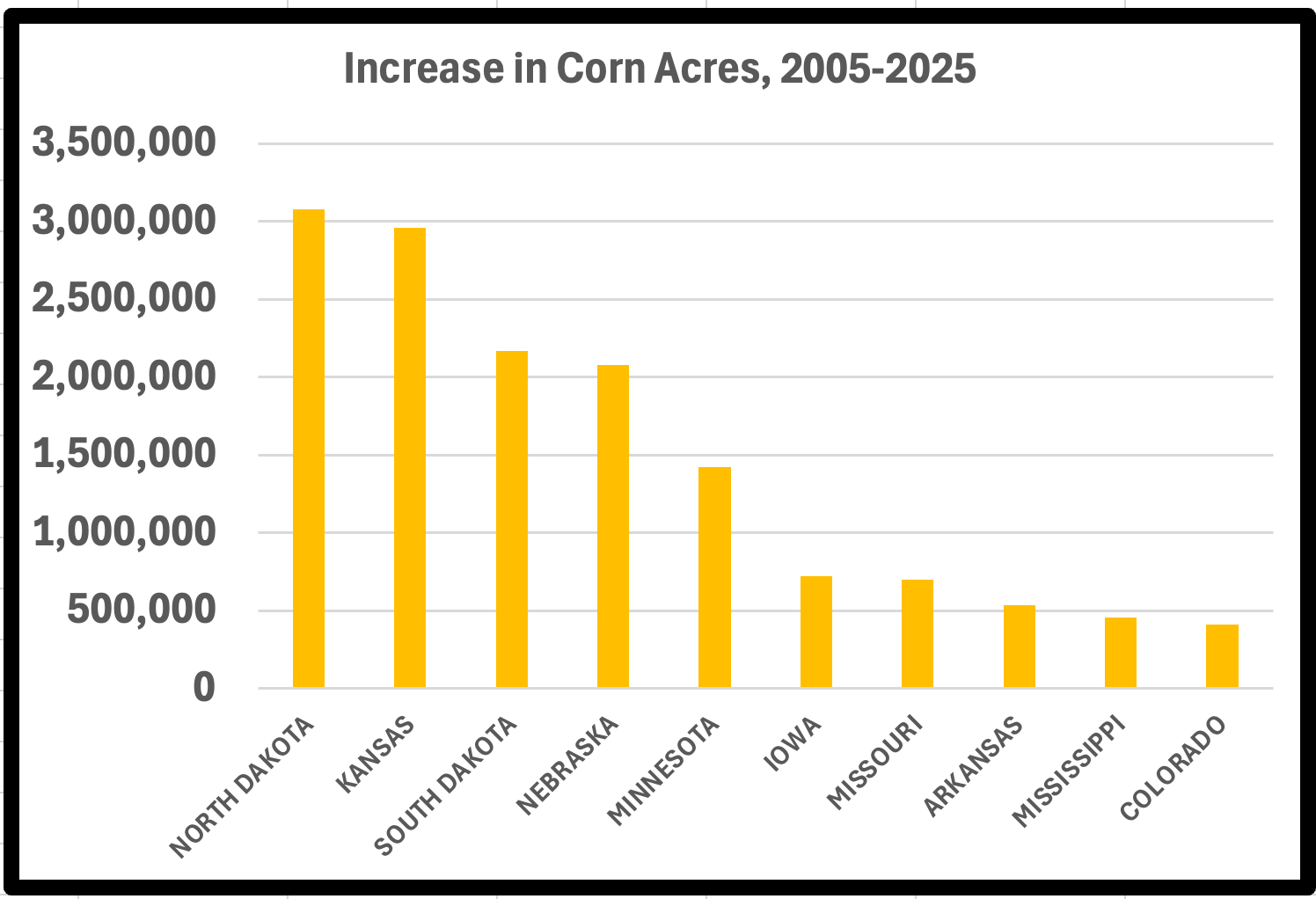
And this didn’t just happen in those ‘corn’ states. Arkansas, Mississippi, Montana, Louisiana, and Oregon all more than doubled their corn area. North Dakota* and Arkansas both more than tripled their corn area in 2025 when compared 2005.
*No wonder Lake Winnipeg is plagued by algae blooms.
The Path Forward
As corn area in the U.S. continues to expand and yields from GMO crops continue to increase, the future of corn ethanol is grim without major government intervention. E15 and carbon capture are bandaids that will indeed prolong the misery of Iowa residents suffering from corn pollution just so the agribusiness titans can squeeze out a few more paydays.
The time to act is now. Let’s create a roadmap to prosperity and better water by forming a ‘coalition of the willing’ ready to talk about alternatives for the 13,000 square miles of land being wasted in Iowa on this transitory fuel. My instinct tells me that those inside the body politic are less willing to have these conversations than are those on the outside looking in.
I’m convinced the potential prosperity and beneficial environmental outcomes those 13,000 square miles could deliver are large indeed. An alternative production scheme focused on high value and low input crops will shame $4 corn diapered by tax payer funded conservation and help restore a rural Iowa degraded by corn ethanol.
It will take courage.
Swenson, D. An Estimate of Ethanol Jobs in Iowa and the U.S.. Department of Economics, Iowa State University, 2011.
Low, Sarah A. and Andrew M. Isserman, Ethanol and the Local Economy: Industry Trends, Location Factors, Economic Impacts, and Risks. Economic Development Quarterly, February 2009 23: 71‐88.
Just musing here. Theoretically, if Iowa's biggest crop were tobacco, would a lot of Iowa's elected officials be declaring that all patriotic and noble-farmer-admiring Iowans (or heck, all Americans) should smoke? At least a little?
Also, I'd be amazed if at least some of that land converted to corn in those other states weren't environmentally sensitive and/or grassland/pasture. North American grassland bird populations are falling faster than those of any other bird group on the continent. And of course in some regions of some states, there is the irrigation/aquifer issue.
Did that economist include all the jobs created patching our roads busted up by trucks hauling corn?