
Testing, Testing, Testing
Test this, not that

The two most important metrics for stream nitrate are concentration and load. Concentration is the amount of a pollutant, i.e. nitrate in this case, per unit volume of water. Nitrate is a negative ion comprised of one nitrogen atom and three oxygen atoms:
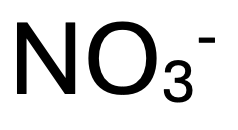
Data for nitrate is most often reported as milligrams per liter (mg/L), which is the same as parts per million. One liter of water weighs 1000 grams at room temperature, 1000 grams is 1 million milligrams and so 10 mg/L is 10 parts in 1 million parts, or 10 parts per million (ppm).
The convention in the United States is to measure nitrate “as nitrogen.” Since one molecule of NO3- weighs 4.43 times more than one atom of N, measurement devices are almost always calibrated with this in mind, so the data you see is “as N” and not “as NO3-.” Nitrate is reported as “as NO3-” in the European Union, and this is often a source of confusion when looking at results and safe drinking water standards.
The maximum concentration of nitrate “as N” allowed in municipal drinking water in the U.S. is 10 mg/L. Long term consumption of water with levels down to 3 mg/L has been found to correlate with many cancers and birth defects. About 800,000 people in Iowa drink such water.
Load is the total mass of a pollutant transported by a stream over a defined time period—day, month, or year, for example. When publishing in scientific journals, the convention is to use kilograms (kg) or million grams (Mg) [note the large “M” here]. One Mg is the same as a metric ton. But when talking to the public and in the context of policy, we often talk about load in pounds.
A 45% reduction in nitrogen and phosphorus loads is the stated objective of Iowa’s flagship water quality policy, the Iowa Nutrient Reduction Strategy. This is aligned with objectives set by the Gulf of Mexico Hypoxia Task Force, as this is the reduction thought necessary to reduce the size of the Dead Zone to pre-1981 levels. Despite what mainly Republican politicians would have you believe, there’s nothing in Iowa’s Nutrient Strategy focused on drinking water quality.
Load is calculated by multiplying the nitrate (as N) concentration in a river by the river’s discharge (flow) and a bunch of conversion factors. In the scientific literature we represent discharge with the letter Q. Complicating matters here is that Q is usually reported in cubic feet per second, which is an English system unit, while N is reported in metric units.
Since both concentration and discharge can change throughout the day, it’s often best to calculate a daily load using the average N and average discharge for the day. The smaller the river, the more things can change during the course of a day.
You can easily obtain loads using the sensor network that’s part of the Iowa Water Quality Information System. Click on the site you’re interested in; here I’m looking at the Iowa River at Wapello in southeast Iowa.
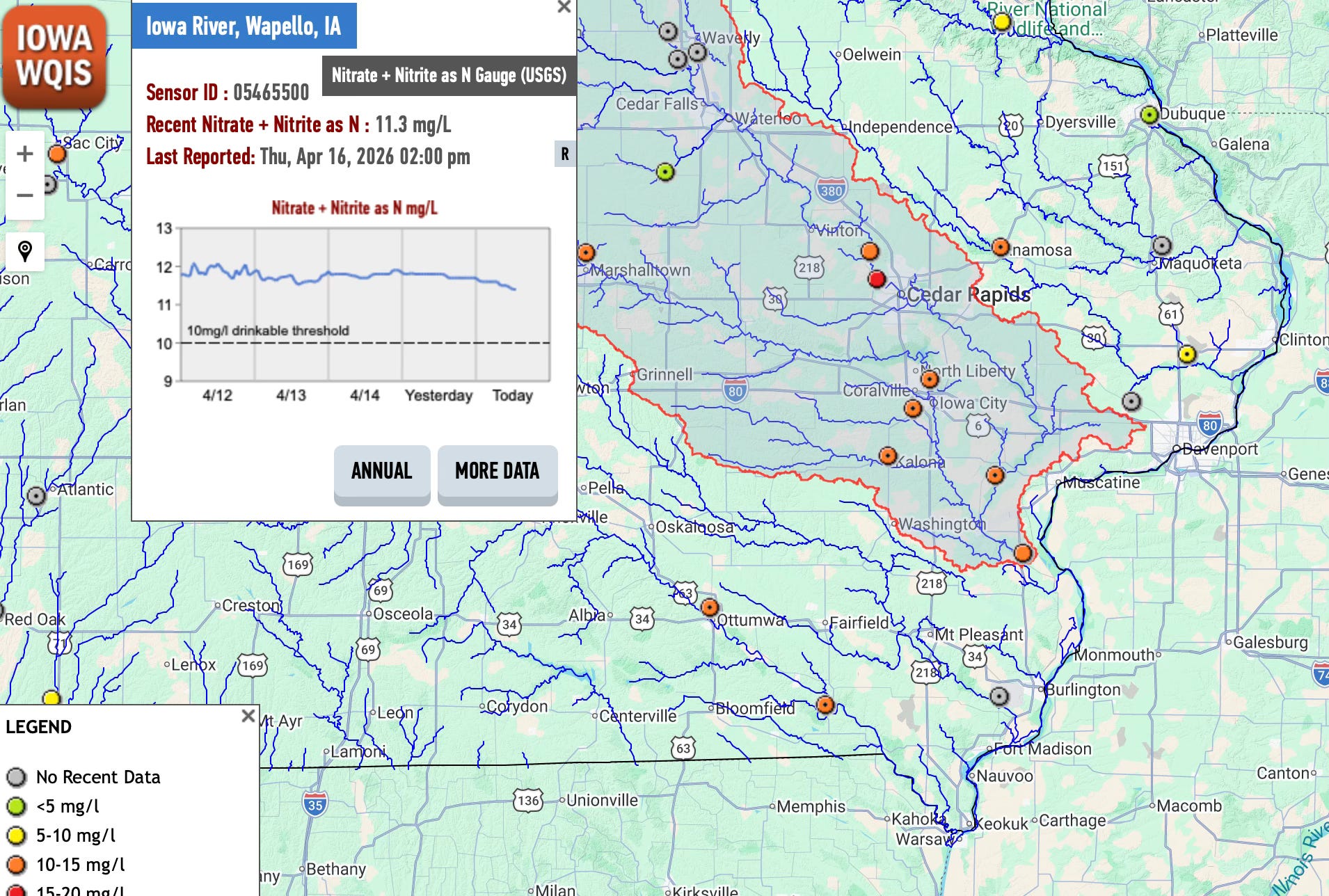
You see immediately that current N concentration is 11.3 mg/L in real time. If you click the “annual” tab, you’ll see a screen that looks like this:
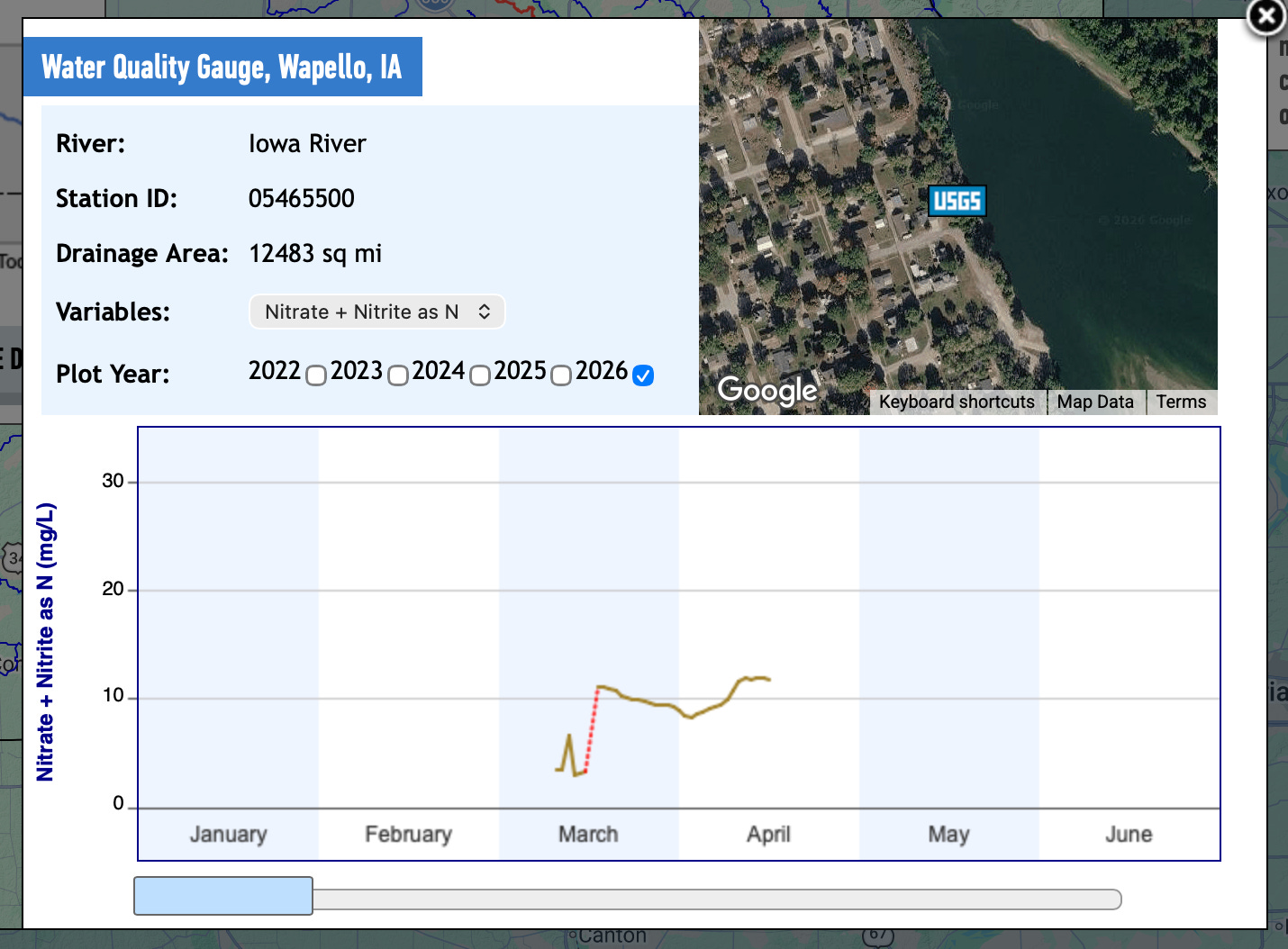
In the “Variables” drop down menu, select N Load.
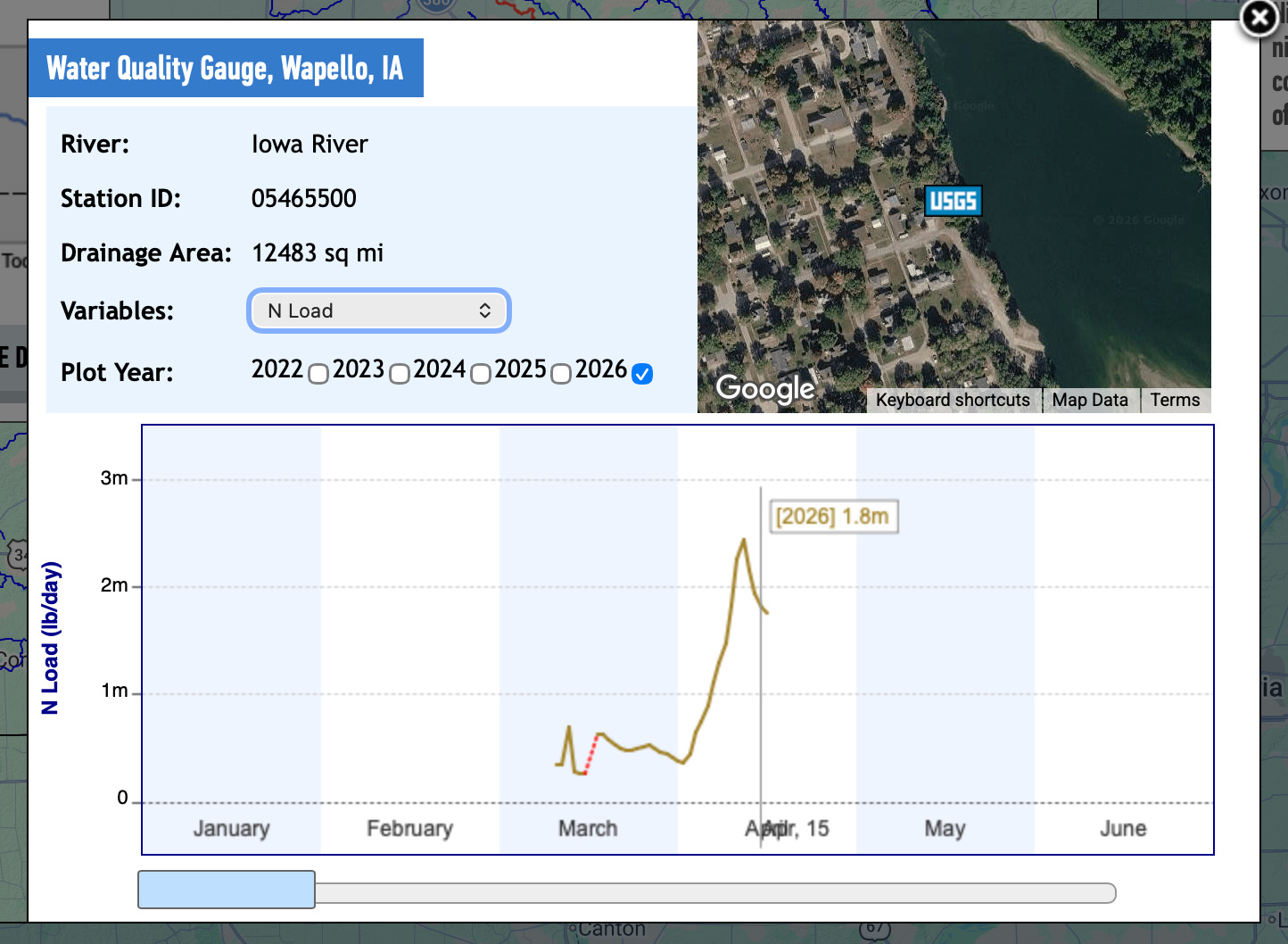
Hover the cursor on the line for the load on the day shown on the x-axis. Here I chose April 15th when the load was 1.8 million pounds.
If you want to geek out or impress your significant other, here is the actual load equation, with Q being discharge and N being nitrate (as N) concentration:

You don’t have to remember all that if you can remember this:
Daily load (lbs) = Q x N x 5.38.
Here are some other loads from April 15th (one day load):
Des Moines River at Keosauqua: 1.1 million pounds
Des Moines River above the Raccoon River in Des Moines: 556,000 pounds
Wapsipinicon River near DeWitt : 437,000 pounds
Raccoon River at Van Meter: 316,000 pounds
Turkey River at Garber: 162,000 pounds
Cedar River at Conesville: 893,000 pounds
West Nishnabotna at Randolf : 56,000 pounds
Nodaway River at Clarinda: 88,000 pounds
Using the data for the Iowa River, Des Moines River at Keosauqua, Turkey, Wapsipinicon, West Nishnabotna and Nodaway, I estimate 57 million pounds of nitrate-N has left the state of Iowa since April 1. About 44.7 million of that went east to the Upper Mississippi; 12.2 million entered the Missouri River first before the Missouri drains into the Mississippi.
Considering that recent rains will keep field tiles running for a while, overall load for the month of April is very likely to exceed 100 million pounds.
Meanwhile, Iowa Secretary of Agriculture Mike Naig announced yet another scheme to blow some more of your money on the problem. Iowa Department of Agriculture and Land Stewardship (IDALS) will provide free soil nitrogen testing to farmers in Webster, Hamilton, Boone, Calhoun, and Greene counties. These counties all drain to the Raccoon and Des Moines Rivers which supply drinking water to the Des Moines metro. The Iowa Nutrient Research and Education Council (INREC), hatched from the Agribusiness Association of Iowa, is also participating. Do you imagine Orwell slow-clapping INREC’s name? I do.
If testing shows your soil already has a lot of nitrogen, then you can logically apply less nitrogen fertilizer. The fact that IDALS and INREC are going to pay farmers to do the testing illustrates that they already know a lot of farmers apply too much, which then helps drive nitrate pollution upward. Anyone working in these circles has long known more than enough nitrogen is applied statewide, but heaven forbid you ever openly talk about it in a meeting attended by someone who has the capacity to put a key scratch on the driver’s side door of your shiny career.
Also….water monitoring—bad. Soil monitoring—good! Needless to say IDALS won’t be offering free tile water nitrate testing any time soon.
Also….if the tests benefit farmers financially, why, for the love of all that is holy, does the testing need to be free? And just so you know, soil N testing is not some exciting, new and emergent technology that needs to be ground-truthed through a fancy pilot program. The test was developed in 1984 and was strongly promoted by ISU faculty member Fred Blackmer in the 1990s. Blackmer’s career was literally covered with key scratches because he had the temerity to often say Iowa farmers were….wait for it….applying too much nitrogen. He died in 2006 of pancreatic cancer.
Finally….This common sense practice has gone largely unused by Iowa farmers for 35+ years and now, at this late date, in an election year, Mike Naig is transforming right before your eyes into an Oprah Winfrey ‘you get new a car’ meme with the soil N tests. What can I say other than maybe there’s still time to name a classroom in Agronomy Hall at Iowa State after Fred Blackmer.
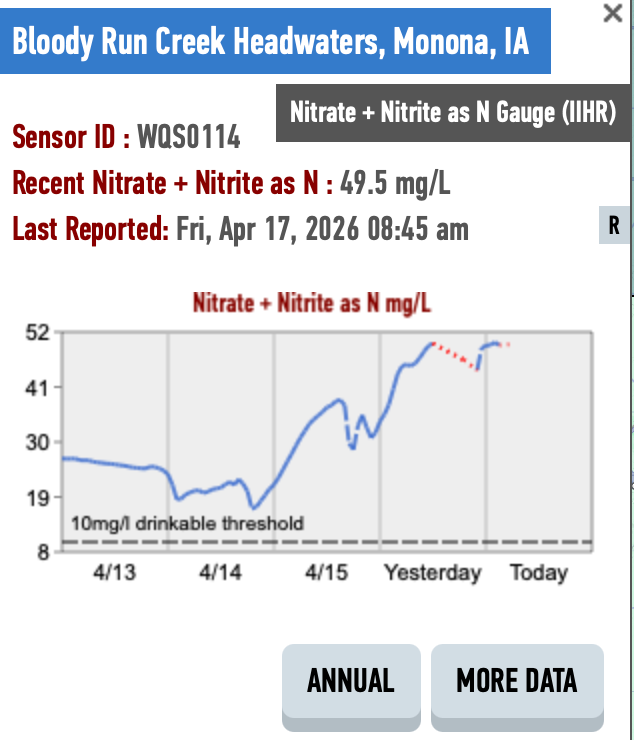
I write this today with a video Iowa Republican-Farmer-Senator Dan Zumbach posted to his Facebook page fresh in my mind. Zumbach, you might recall, sponsored the 2023 bill to end funding for the Water Quality Information System. His son-in-law is one of the owners of the 10,000 head cattle operation near the headwaters of Bloody Run Creek in Northeast Iowa. The stream is monitored by two real-time nitrate sensors, one not far from the cattle operation. It’s reading about 50 mg/L today, and has approached that level on previous occasions this year. Since the maximum concentration the device can register is 50, it’s possible the device is “pegged” and the nitrate might actually be higher.
In his Facebook video, Dan unloads a number of whoppers, all while applying fertilizer to his farm.
Example: “Folks, there’s a lot of people out there reporting how bad our water quality is, that is just not true.”
He references a nameless report produced by “sources he trusts”, Iowa DNR, IDALS and ISU, that says water quality is improving. Maybe it’s just me, but if you honestly think water quality is improving, wouldn’t you want the water monitoring data that the water quality sensor network can generate?
Just an fyi, the Iowa Nutrient Research Center at Iowa State shows 2024, the latest year reported, to be the worst of the last 25 years for Iowa stream nitrate loading.
Also, says Dan, “We’re going to keep improving water quality with our equipment and the expertise that we have so that we can keep improving water quality for me, you, my grandkid, and your children too.”
Dan apparently is a model Iowa farmer, as he was awarded the 2024 Iowa Soybean Association’s (ISA) Friend of the Iowa Soybean Farmer Award, presented by Cargill. Dan ran for Iowa Secretary of Agriculture in 2018, losing in the primary to Naig. He farms in Delaware County, home to one of Iowa’s worst drinking water nitrate problems, this in its largest city of Manchester. One sample measured 10.2 mg/L in 2025.
Dan has also shown he can reap more than the just corn and soybeans. He’s harvested $1.22 million in USDA subsidies during his farming career.
No sensors in the triangle below Des Moines and to Ottumwa/Bloomfield and Red Oak/Clarinda. Crazy. It's almost as if Republicans don't want us to know what's going on.
Thank you, thank you, Chris!! I'm so grateful that you used this topic for another great post. When I first saw the IDALS press release about the free soil testing, my outrage was so loud my cat left the room. And that was before I read elsewhere that this first round of free soil testing will set Iowa taxpayers back, as I recall, more than $300,000.
We are all going to pay for soil testing that should already be universally done and taken for granted as fundamental to responsible intelligent farming. What could be more basic for a good farmer than knowing what's in their soil??? Publicizing a program that essentially begs farmers to test their soil for free is open acknowledgement that most Iowa farmers and landowners are not testing every year already. In a sane smart state, that would be a major political embarrassment to the ag industry. But here, where ag gets away with everything, it's just Iowa being Iowa.