
The Long Con
...and Farce to Faucet, explained

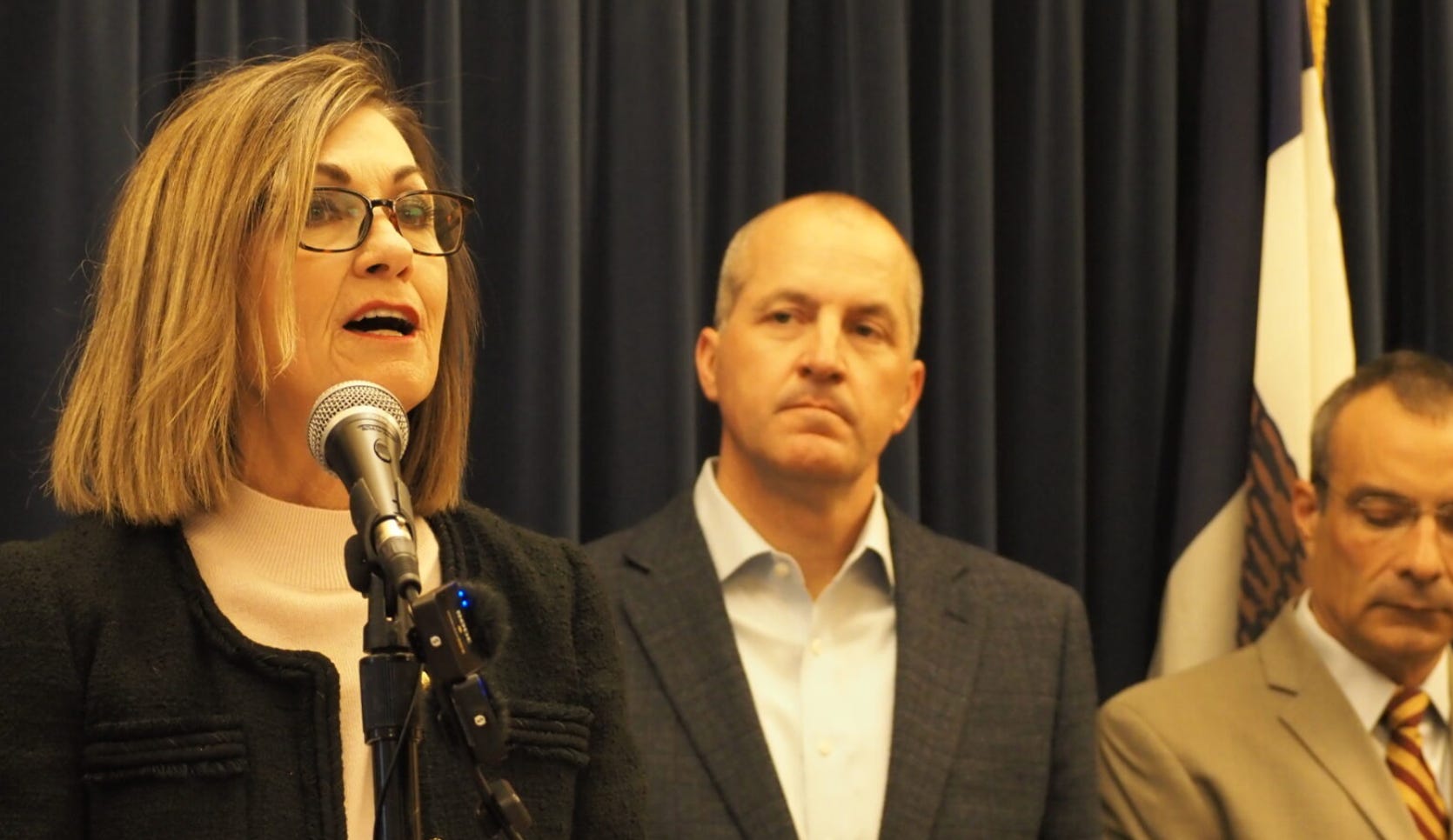
As the midnight hour fast approached for the 2026 legislation session, someone apparently informed Iowa Secretary of Agriculture Mike Naig and Governor Kim Reynolds that drinking polluted water might be an issue in the 2026 election. One week ago today on May 1st, Naig and Reynolds nervously announced their latest water quality con, that being the future expenditure of $319 million of taxpayer money over the next 12 years to address the state’s nitrate problem. Reynolds was so tongue-tied with stammering and mispronunciations that she practically begged someone else to take the podium.
The Naig/Reynolds scheme (dubbed as Farm to Faucet) focuses mainly on drinking water and wastewater infrastructure, especially infrastructure for nitrate mitigation. Reynolds and Naig each have been in office for nearly a decade, with Naig coming to state government after lobbying our government as a Monsanto representative. They’ve done nothing to change the fact that one-third of Iowa’s 1077 community water systems are vulnerable to nitrate contamination, or to protect Iowa’s private drinking water wells, 6600 of which (that we know of) have been contaminated with the pollutant. Municipal drinking water in many of Iowa’s large and medium-sized cities is impacted by nitrate pollution including the Des Moines metro, Cedar Rapids, Iowa City, Cedar Falls, Waterloo, Ottumwa, Manchester, Independence and Boone.
Without getting too far into the weeds of the Naig/Reynolds plan, it’s important to point out the plan requires the industry responsible for the pollution (agriculture) to be accountable NOT AT ALL, nor does it require them to pony up even a Republican red cent to help mitigate the problem. The taxpayer is required to shoulder the entire burden of this 50-year long problem. If you’re not outraged by that, I’m not at all sure that I’m capable of summoning the words to change your mind. The plan was added to the budget bill as an amendment at the last minute, without committee hearings and without public comment.
The plan initially was to include $500,000 for new water quality monitoring to be coordinated by Iowa DNR, while at that time (i.e. 5/1) the legislature apparently intended to fund the real-time water quality sensor network at $300,000. By the end of the weekend, however, the $500k was changed to $300k and the $300k for the sensor network had disappeared into Republican pond scum.
Perhaps most curiously, the plan included $25 million for Central Iowa Water Works/Des Moines Water Works to double their nitrate removal capacity. Where that number came from is anybody’s guess. The current nitrate removal system at the Des Moines Fleur Drive Treatment Plant, the world’s largest such facility, cost $4 million in 1992. Typically these sorts of things require an engineering study that includes climate, population, energy and water quality projections and land acquisition. In addition, doubling the nitrate removal capacity will also at least double the waste created by the treatment process. So this requires study on the back end also, i.e. sewer main capacity and treatment capacity at the Des Moines Wastewater Treatment Plant, along with costs for treatment. No such studies were conducted before Naig and Reynolds threw the Hail Mary plan into a press conference scrum and declared a legislative policy victory. I can tell you with some certainty that many people knew about the $25 million scheme well before folks at DMWW/CIWW had a clue it was coming.
When I started work at the Des Moines Water Works in 2003, Iowa DNR was beginning the process of producing Total Maximum Daily Load (TMDL) assessments of nitrate for Iowa rivers. This is a requirement of the Clean Water Act for water bodies that are ‘impaired’. DNR began with the Cedar River (and not the Des Moines or Raccoon Rivers supplying Des Moines) because, we at DMWW were told at the time, the nitrate problem was more urgent in Cedar Rapids because Des Moines already had nitrate removal, while Cedar Rapids did not (and still doesn’t). I mention this because over the past decade or so, the City of Cedar Rapids has mostly gone all in with Naig’s voluntary approach to water quality improvement, while Des Moines filed the hated (by agriculture) lawsuit asking redress for the nitrate problem from three upstream counties. It’s then with some irony here that CR got stiffed by Farce to Faucet while DM gets gifted 25 extra large. But math is math even for someone like Naig, and there are more votes in Polk County than in Linn County.
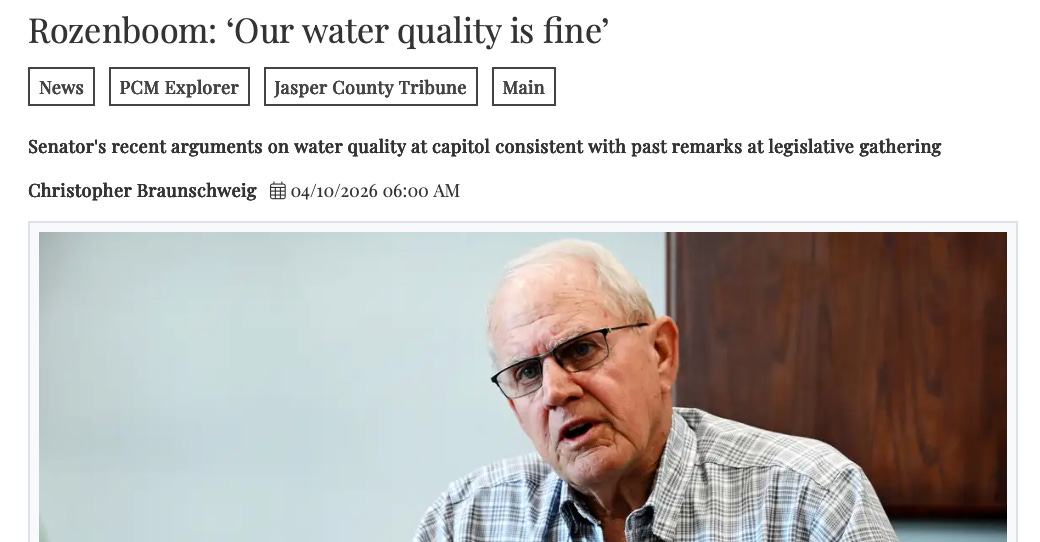
Some of Reynolds’ and Naig’s best friends attended this press conference: Iowa State Senators Ken Rozenboom, Dan Zumbach, Tom Shipley, and Annette Sweeney, and State House Representative Norlin Mommsen. Interestingly, Iowa State University Professor Mike Castellano was also present.
Curiosities abound here and one might wonder why Zumbach and Rozenboom were at the press conference, since they both are on the record as saying there is nothing wrong with Iowa water. If that’s the case, why go along with blowing $319 million of taxpayer money to cope with the problem? Unless of course this is a vote buying scheme and not a water quality improvement plan.
By all appearances, the upcoming election looks to be a tough one for Republicans and a referendum on President Trump both in Iowa and nationally. Trump has looked at the Iowa farm economy like it was a New Jersey casino in need of bankrupting, and Naig has objected not at all to The Don’s policies as oligarchs, quarterbacks, hedge funds and the Mormon church gobble up Iowa farmland. Funny how Republicans frequently tout how outraged they are at the prospect of Chinese people buying Iowa Farmland, but care little or not at all about these other land grabs.
It’s also curious that ISU professor and celebrated nitrogen researcher Castellano attended the press conference. He lended moral support to Naig’s repeated assertion that the nitrate problem is one of weather and soil. You might find it interesting that Castellano is the lead researcher for the Iowa Nitrogen Initiative, a project funded by Naig’s Iowa Department of Agriculture and Land Stewardship (IDALS) to the tune of $1 million per year since 2022, and a project that is likely to continue as long as Naig is at the helm at IDALS. I know, I know, bread, butter, something, something, something. So much for the lofty ideals of the Ivory Tower.
Scientists deciphered the entire human genome in 13 years, but after 50 years of study, we’re still doling out a million per year for university faculty to fart around with nitrogen application rates to corn while you, the taxpayer and water rate payer, are forced to pay for the pollution with your money and your health. I’m not saying such research doesn’t add to our knowledge base, but there’s a huge opportunity cost incurred by continuing to dump money into this sort of thing. There’s more to life (and agriculture) than corn, for crying out loud. Iowa Republicans (and a lot of Democrats) and ISU faculty haven’t received that memo, apparently.
I’ve been arguing for years that bad water is self perpetuating in Iowa largely because our institutions have been compromised by the Big Ag Behemoth. So naturally I take some satisfaction when someone like Castellano confirms it for me and my readers.
Your analysis of Iowa’s water crisis—and the last-minute results of the final legislative session through the lens of the “Farm to Faucet” concept/con—is brilliant. You connected policy, agriculture, and public health in a way that makes the stakes both understandable and impossible to ignore.
The Republicans have figured out that people have figured it out. Yesterday I was at a protest in Davenport with about 40 other people organized by Food and Water Watch. The point was that Miller Meeks helped screw up Medicaid, which is bad news in a state with polluted drinking water and a high cancer rate. I'd say about 75% of the drivers going by honked in support or gave us the thumbs up.