
You Heard it Here Second
Architecture gives me a headache

There’s no apparent end in sight for the elevated nitrate episode affecting the Des Moines area’s municipal water supply. Data from the Des Moines Water Works (DMWW) website shows the treated drinking water from the Fleur Drive treatment plant exceeding 8 mg/L nitrate-nitrogen every day since April 18. The lowest reading of the year was recorded on January 1st (6.89 mg/L).
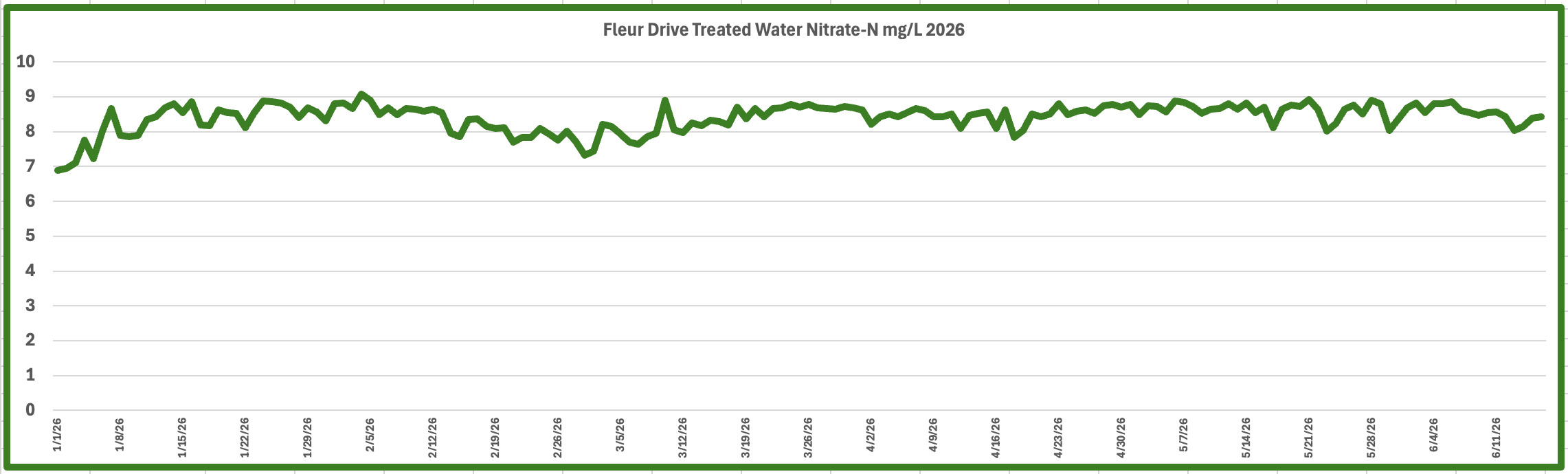
Central Iowa Water Works (CIWW) is the regional water utility overseeing DMWW and suburban utilities, and it mandated outdoor water use restrictions on June 8. This is necessary because the utility’s nitrate removal capacity is insufficient when high nitrate episodes are concurrent with above average water demand. The utility is also urging residents to curtail indoor water use.
Des Moines Water Works customers found watering lawns will be warned with a tag left at the property. If watering is observed again within 48 hours, the customer will be soaked with a $70 fine and their water service will be terminated. Service will be restored only when the customer agrees in writing to comply with conservation rules.
The irony here is that users of the water resource (YOU) are subject to regulation while the pollution itself goes unregulated. The big fertilizer corporations (Koch Industries, Nutrient, CF Industries) and retailers (NEW Cooperative, Heartland Cooperative, AgState, to name a few) get off scot-free, extracting wealth from our state while leaving us with a pollution-induced scarcity and increased risk of cancer.
There are many ag apologists that want to point the finger at population growth as the reason for Des Moines’ recent water quality problems. As such, they want you and other taxpayers to fund capital improvements for municipal drinking water upgrades to cope with nitrate pollution. Governor Kim Reynolds and Secretary of Agriculture Mike Naig recently unveiled their “Farm to Faucet” legislation that does just that, and it was passed by the Iowa legislature the last weekend of the 2026 session. Hannah Inman, CEO of the Great Outdoors Foundation praised this approach just today (6/21/26) in the Des Moines Register, saying that “This is real progress, and it deserves to be recognized as such.”
One could say, if that one is me, that it’s yet one more example of ungovernable corporations giving the public the middle finger while our politicians and Inman ask us to pay to mitigate the pollution with our tax dollars.
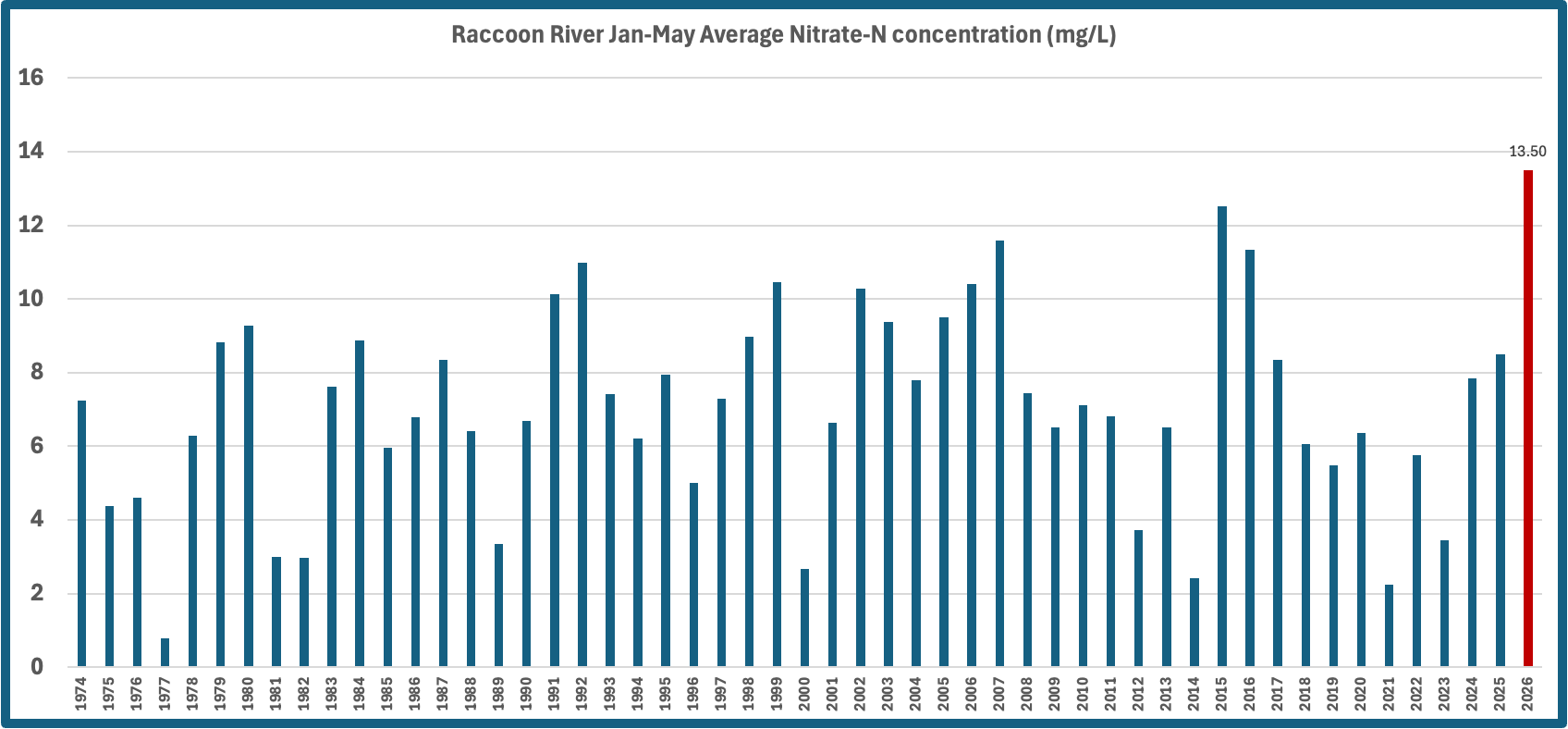
Central Iowa’s primary drinking water source is the Raccoon River. How have nitrate concentrations been in the river this year? Using the words of Samuel L. Jackson in Jurassic Park, “hold on to your butts.”

So far this year, nitrate levels in the Raccoon have been the highest they’ve ever been (13.5 mg/L) over past 52 years for the January to May calendar period. The previous highest year was 2015, when the average concentration was 12.5 mg/L, Jan-May. Through June 16th, Raccoon River nitrate-N has been below the drinking water standard of 10 mg/L on only 16 of the 167 calendar days.
Why is river nitrate so high around Iowa this year? Mike Naig will tell you it’s the weather, and the soil. Or the soil, and the weather. Hannah Inman tells us it’s because we lack the public funding architecture (why do I suddenly have a migraine?) to shovel even more public money to provide cover for the majority who aren’t compelled to do anything. Iowa farmer Wendy Johnson, on the third hand, told you in her guest post here that maybe, just maybe, it’s because farmers routinely oversupply fertilizer because of crop insurance architecture. [READER: Wendy did not say ‘architecture’. I just thought it might make my headache go away if I used the word at the end of a three-word phrase. It didn’t.]
Might I suggest Wendy is the wisest here.
CIWW Executive Director Tami Madsen continues to use the rhetoric of “the water is safe” because the treated drinking water has not exceeded the 10 mg/L federal standard for nitrate-nitrogen. That standard was set in 1974 and was intended to be protective of infants consuming baby formula made with nitrate-laden water. Such children are vulnerable to methemoglobinemia, or ‘blue baby syndrome.’ I’m sure Madsen is aware of the voluminous amount of research produced since 1974 (and especially since 2000) showing water containing nitrate down to 3 mg/L associated with a host of cancers and birth defects. But since EPA continues to decline to modify the standard, Madsen and other water utility spokespeople around Iowa have license to take cover behind them. Bear in mind that EPA is also the agency telling us the Raccoon River is not impaired for nitrate. So there’s that.
I was an Iowa-certified Water Treatment Plant Operator until I retired, and I find it interesting that Iowa utilities are now casually tossing around the ‘safe’ lingo when discussing nitrate. My recollection of the conventional wisdom in water supply was that we were never supposed to use the word safe, because, well, you never really know for certain and claiming an absolute like ‘safe’ left the utility vulnerable to lawsuits, should someone become ill. The thinking was that meeting the legal standard does not and should not imply risk-free. Perhaps the thinking on that has changed. More likely is the politics of nitrate pollution in Iowa has changed since I was working.
That all being said, I applaud DMWW and CIWW for posting their treated water nitrate levels on a near daily basis. Social media videos are everywhere showing people using nitrate test strips on their own tap water. These are completely unnecessary in Central Iowa because of the fine job DMWW does with data transparency. I have to believe that there are few water utilities in the country that are better at this than DMWW. Other Iowa communities would do well to follow their lead.
Governor candidate Rob Sand has spoken of a “nitrate warning system”; DMWW’s water quality website would be a very satisfactory starting point for that.
You can get data for your community through the Iowa DNR Drinking Water Portal. But navigating the site’s architecture (oh my aching head) is worse than kissing a rattlesnake and nitrate data for most communities is only posted on a monthly or quarterly basis, depending upon the water utility’s operating permit. Lucky for you, I kissed the rattlesnake while writing this, and retrieved some data for communities around Iowa that I knew had elevated nitrate:
Iowa City
2/10/26: 8.2 mg/L
4/6/26: 6.9 mg/L
5/22/26: 7.7 mg/L
6/9/26: 7.3 mg/L
Manchester
4/1/26: 8.7 mg/L
6/3/26: 8.7 mg/L
Cedar Falls
Most samples between 8.8 and 9.7 mg/L during 2026
Waterloo
4/7/26: 9.3 mg/L
6/3/26: 7.9 mg/L
Boone
6/2/26: 8.9 mg/L
all 2026 samples above 6 mg/L
Ottumwa
2/4/26: 9.4 mg/L
5/5/26: 8.0 mg/L
all 2026 samples above 7 mg/L
Cedar Rapids
5/27/26: 7.3 and 6.6 mg/L
4/29/26: 8.9 mg/L
4/22/26: 8.7 mg/L
most 2026 samples above 7 mg/L
Independence
6/8/26: 7.5 mg/L
It is sad that the finger pointing continues instead of actual solutions. The fact that the average homeowner is responsible for all the water woes is asinine. Thank you for your sincere attention to this problem. Make sure you drink plenty of filtered water for your headache.
The American dream is being subverted by corporations, and it's time we yanked it back.